
Your Casino’s Game Lobby Has a Search Bar and a Filter System. Here’s Why Neither One Shows You What You Actually Need to Know.
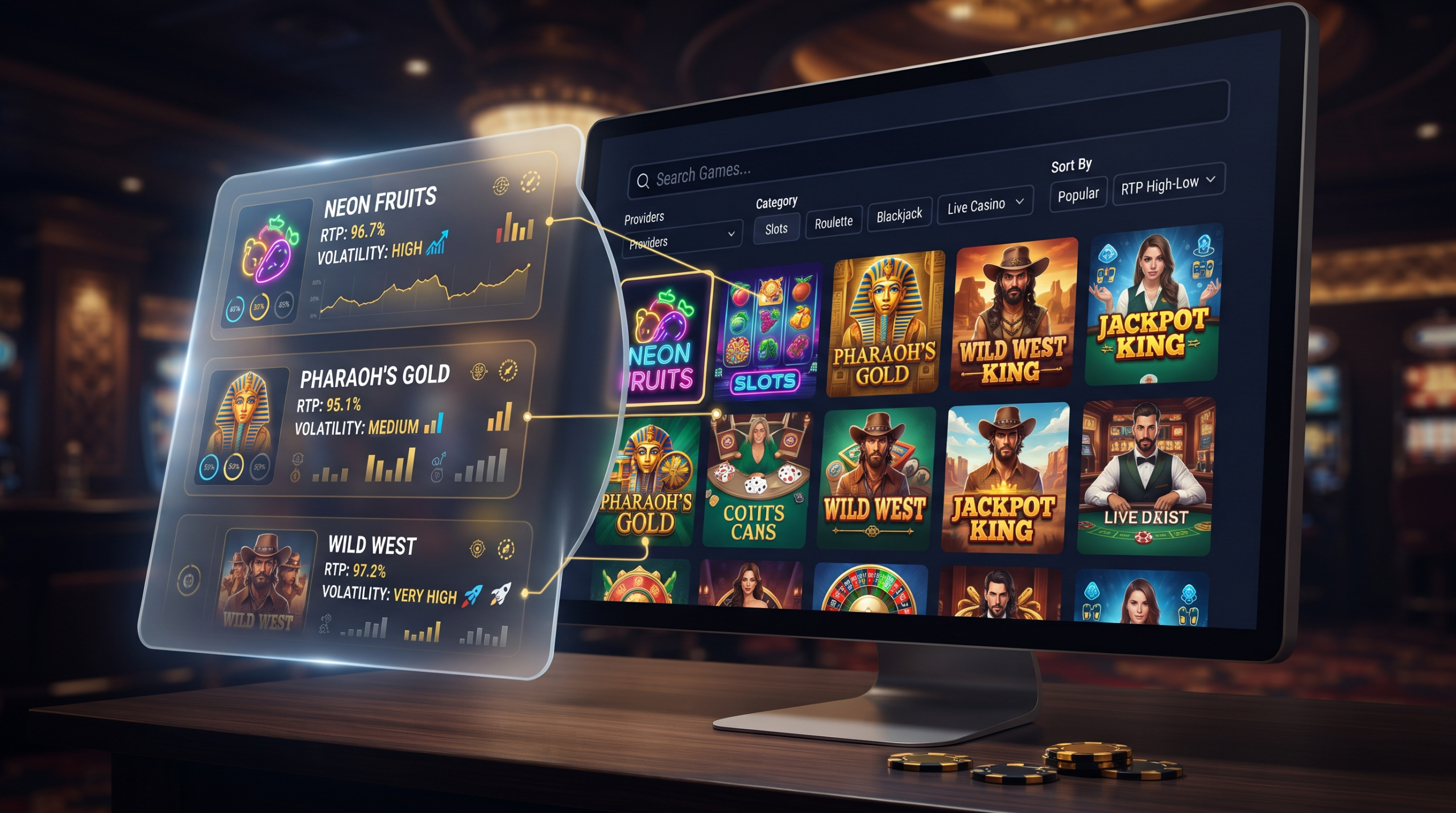
Every Canadian online casino lobby is designed to do the same thing: get you clicking on a game as fast as possible. The search bar finds titles by name. The filters sort by provider, theme, or category. New releases sit at the top. Popular games get a dedicated row. The entire interface is built around discovery, and it’s genuinely good at it. What it never surfaces, not once, is the single piece of information that matters most to your session: how the game actually behaves with your money.
RTP, volatility, hit frequency. These are the numbers that determine whether your bankroll lasts forty-five minutes or twelve. They’re the difference between a slot that pays small amounts constantly and one that goes cold for two hundred spins before delivering a single large hit. And they’re nowhere in the lobby. Not in the filters. Not in the search results. Not in the thumbnail. You have to open the game, find the info screen, and read the paytable yourself. Most players never do.
That’s not an accident. The lobby is a storefront, and storefronts are arranged to sell. Understanding what’s behind the arrangement changes how you use it.
What the Lobby Actually Sorts By
Open any major Canadian-facing casino and the filter options are roughly identical. You’ll see provider (Pragmatic Play, NetEnt, Microgaming/Spin Genie, Play’n GO), game type (slots, table games, live casino, jackpots), and sometimes theme (Egyptian, adventure, fruit). Some lobbies add a “New” tab and a “Popular” or “Hot” tab. A few let you sort alphabetically. That’s it.
None of these filters tell you anything about how the game plays. Sorting by provider tells you who built it. Sorting by theme tells you what it looks like. The “Popular” tab tells you what other players clicked on, which is a measure of marketing spend and brand recognition, not game quality. Mega Moolah sits in the popular tab because everyone’s heard of it, not because its base game RTP of 88.12% is competitive. It isn’t.
The search bar is useful if you already know what you want. If you type “Starburst,” you’ll find Starburst. But if you type “high RTP” or “low volatility,” you’ll get nothing. The search indexes game names and sometimes providers. It doesn’t index the mechanical properties that define your experience.
Why RTP and Volatility Aren’t in the Filter
There’s a practical reason and a commercial one. The practical reason is that RTP isn’t always fixed. Many modern slots ship with multiple RTP configurations. Pragmatic Play’s Sweet Bonanza, for example, has a default RTP of 96.48%, but operators can select a 95.45% or 91.67% version. The lobby would need to display the specific configuration that operator is running, not the provider’s headline number. That requires transparency most operators aren’t volunteering.
The commercial reason is simpler. An RTP filter would let players sort from highest to lowest and ignore everything below 96%. That’s bad for operators who run lower-RTP configurations, and it’s bad for providers whose games sit at 94% or 95% by design. The lobby’s job is to spread play across the catalogue, not concentrate it on the twelve games with the best return. A volatility filter would create similar problems. Players looking for longer sessions would filter out every high-volatility title, which is exactly the category that generates the largest average losses per session.
I’ve seen enough lobbies across enough operators to know this isn’t a technical limitation. It’s a design choice. The information exists. The provider data sheets list RTP and volatility for every title. The decision not to surface it in the lobby is deliberate.
The “Popular” Tab Is a Feedback Loop
The games in the popular or trending section aren’t there because they’re objectively better. They’re there because they were played more, which usually means they were promoted more, placed higher in previous lobby positions, or featured in welcome bonus free spin packages. Gates of Olympus appears in nearly every Canadian lobby’s popular tab. It’s a strong game, but its presence there has more to do with Pragmatic Play’s distribution deals and operator promotions than with players independently discovering it.
This creates a feedback loop. Games placed prominently get played more. Games played more get placed in the popular tab. Games in the popular tab get played even more. New titles from smaller providers rarely break into this cycle unless an operator actively features them, which typically involves a commercial arrangement. The lobby rewards incumbency, not quality.
For players, the practical effect is that the popular tab is a list of games the operator wants you to see, presented as a list of games other players chose. Those aren’t the same thing.
Where the Actual Information Lives
Every regulated slot is required to display its RTP and rules within the game itself. The info screen, help menu, or paytable section contains the return-to-player percentage, the volatility rating (if the provider includes it), the hit frequency (rarely), and the full bonus mechanic explanation. This is the actual product specification. It’s just buried two or three clicks deep inside each individual game.
To find it, open the game in demo mode if available, look for a menu icon (usually three horizontal lines or a question mark), and navigate to the game rules or paytable. The RTP will be listed there. Under Ontario’s regulatory framework, operators running a lower RTP configuration than the provider’s default are expected to display the actual RTP the player is experiencing, not the provider’s headline figure. Check that number. If the game shows 94.50% and the provider’s spec sheet says 96.50%, you’re playing a reduced configuration.
This process takes about thirty seconds per game. But multiply that by the three hundred to two thousand titles in a typical lobby and it becomes clear why most players never check. The information is technically accessible and practically invisible.
What You’d Actually Want a Filter to Show
If a lobby were designed for the player instead of the operator, the filter panel would include three things. First, RTP range: let players set a minimum, say 96.00%, and hide everything below it. Second, volatility level: low, medium, high, with a plain-language description. Low volatility means frequent small payouts and longer sessions on the same bankroll. High volatility means long cold stretches punctuated by larger, less frequent hits. Third, the actual RTP configuration running at that specific operator, not the provider default.
No major Canadian-facing casino offers all three. A small number of operators have begun adding a volatility indicator to game thumbnails, but it’s inconsistent and often uses the provider’s marketing label rather than a standardised scale. The gap between what the lobby shows and what the player needs remains wide.
Third-party databases exist that catalogue RTP and volatility by title. They’re useful as a starting point, but they typically list the provider’s default RTP, not the configuration your specific operator is running. The only reliable source for the actual number is the info screen inside the game at the casino you’re playing.
How to Use the Lobby Without Trusting It
The lobby isn’t useless. It’s just not designed to answer your most important questions. Use it for what it does well: finding games by name, browsing by provider if you know which studios you prefer, and identifying new releases you might want to investigate. Then do the investigation yourself.
Before committing real money to any game, open the info screen and check the RTP. If it’s below 95%, understand that the house edge is meaningfully larger than the category average. If the volatility is listed as high, budget for at least 200 to 300 spins at your chosen bet level to give the game a reasonable chance to hit its features. At $0.20 per spin, that’s $40 to $60. At $1.00 per spin, that’s $200 to $300. The lobby won’t tell you this. The math will.
If you’re choosing between two games that look equally appealing, the one with the higher confirmed RTP at your operator is the better mathematical choice over a long session. That’s not a guarantee of results. It’s a structural advantage that compounds over hundreds of spins.
Honest Assessment
The casino game lobby is a well-designed shop window, and there’s nothing inherently wrong with that. Operators have commercial interests and the lobby reflects them. The problem is that players treat the lobby as a neutral tool when it’s actually a curated presentation. The filters sort by everything except the variables that determine your bankroll outcome. The popular tab reflects marketing momentum, not game quality. The search bar finds names, not properties.
Until operators start surfacing RTP and volatility in the lobby interface, and specifically the RTP configuration they’re actually running, the burden falls on the player to check. It shouldn’t, but it does. The thirty seconds it takes to open a game’s info screen and read the actual RTP before you bet is the most valuable habit you can build. No filter will do it for you.
The lobby is built to get you playing. The info screen is built to tell you what you’re playing. They’re in different places for a reason, and the reason isn’t technical. Knowing that changes nothing about the interface and everything about how you use it.
Gambling is entertainment with a cost attached, so set limits before you play and visit our Responsible Gaming page for support resources, safer-play tools, and help options if gambling stops feeling fun.

Leave a Comment