
The Simplest Game in the Casino Is More Interesting Than It Looks.
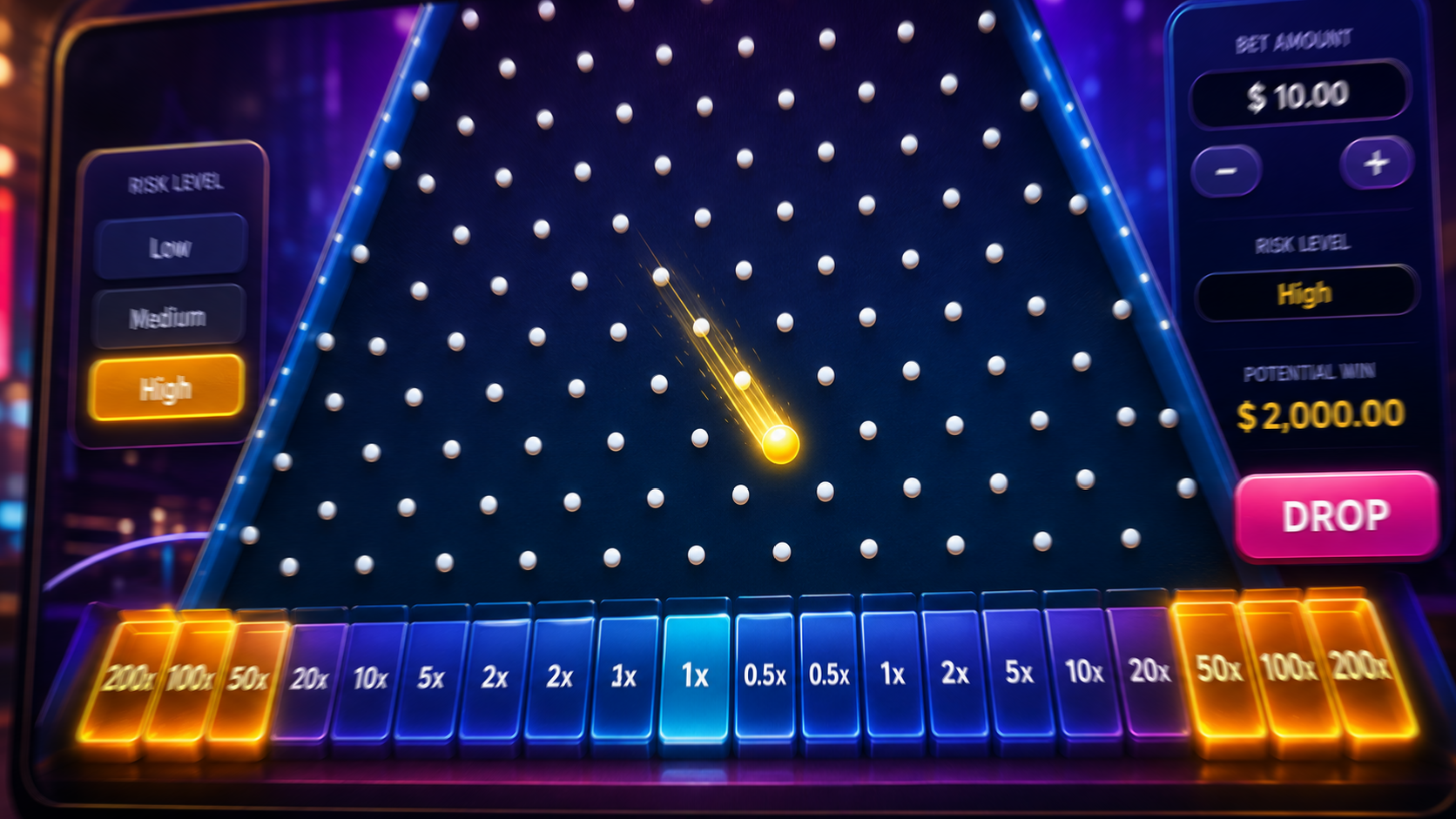
Plinko shouldn’t work as a casino game. There’s no story, no characters, no bonus round to unlock, no free spins to trigger. You drop a ball. It bounces off some pegs. It lands somewhere. That’s the whole thing.
And yet I keep coming back to it. I’ve sat with this game longer than I expected to, across different risk settings, on different platforms, trying to figure out exactly what it’s doing to my brain. I think I’ve got it now.
It’s a Physics Game Pretending to Be a Casino Game
The first thing that grabs you about Plinko is that it feels intuitive in a way that slots don’t. A slot spin is abstract — symbols appear, a result happens, and the math behind it is completely invisible. With Plinko, you’re watching a ball travel a physical path. You can see every peg it bounces off. The outcome feels earned rather than generated.
That feeling is real, and it’s also slightly misleading. The ball’s path is determined by an RNG — a random number generator — just like every other casino game. The pegs are visual feedback, not mechanical cause. But watching a ball ricochet its way down a board is genuinely more engaging than watching reels spin, and that engagement is part of why the format has exploded.
There’s something almost meditative about it. Drop, bounce, land, repeat. The rhythm is its own kind of hook.
The Peg Board Has a Secret
Here’s the part that makes Plinko more interesting than it first appears.
The board is shaped like a triangle — narrow at the top, wide at the bottom. A ball dropped from the centre of the top has dozens of paths available to it as it works its way down through the pegs. Most of those paths end up somewhere in the middle of the bottom row. Very few end up at the far edges.
This isn’t bad design. It’s probability in physical form. Each time the ball hits a peg, it goes left or right. Over many bounces, those random left-right decisions average out toward the centre more often than the edges. It’s the same reason that if you flip a coin a hundred times, you’ll get somewhere around fifty heads — not because the coin is fixed, but because that’s how randomness works at scale.
The payout slots at the bottom reflect this. The centre pays low multiples. The edges pay high ones. The rare outcome gets the big reward. The common outcome gets a modest one.
So far, so standard. Now here’s where it gets genuinely interesting.
The Risk Slider Is Doing More Than You Think
Most online Plinko games give you a risk setting — low, medium, or high. I ignored this for longer than I should have because it looked like a simple volatility toggle. It isn’t. It restructures the entire game.
On low risk, the payout distribution is compressed. The centre pays close to your stake back, the edges pay a decent multiple, and the range between the two isn’t dramatic. You’ll lose slowly, occasionally win something decent, and the session stays relatively stable. It’s almost relaxing.
On high risk, the board becomes extreme in both directions. The centre payout drops to a fraction of your stake — sometimes as low as 0.2x or 0.3x — while the edge payouts shoot up dramatically. Most drops return less than you put in. The rare edge landing returns significantly more.
I spent a session on high risk and the honest description is: it feels like standing next to a slot machine that takes a tiny bite out of you every few seconds and then occasionally, without warning, gives you a substantial chunk back. The pacing is strange. The dry stretches feel longer than they are because each individual result is so visible and so immediate.
What makes it compelling is that moment when the ball starts drifting toward the edge. You can see it happening in real time. The tension is genuine, not manufactured by an animation. By the time it settles into an outer slot — or clips the last peg the wrong way and lands one slot too far in — you’ve been watching it travel for several seconds. That’s more drama per drop than most casino games manage.
Low vs. Medium vs. High: Which One Is Worth Your Time
Low risk is the right setting if you want to stretch a session, stay in the game for a while, and aren’t chasing big payouts. It’s also the setting I’d recommend for anyone playing Plinko for the first time. The stakes feel manageable and you get to actually understand how the board works before you dial up the variance.
Medium risk is my personal preference. There’s enough range in the multipliers to make edge landings feel like events without the brutal sub-stake returns of the high setting. You’re still going to have stretches where the ball clusters toward the centre, but they don’t feel like punishment.
High risk is genuinely fun if you go in knowing what it is. It’s a patience game with occasional drama. If that sounds appealing — and for some players it genuinely does — then the high setting delivers it. Just understand that a run of centre landings on high risk can drain a budget quickly in a way that the same run on low risk simply wouldn’t.
Same game. Very different experience.
Why It Works So Well on Mobile
I play a lot of casino games on mobile and Plinko is one of the few that actually improves on a phone screen. The vertical board suits portrait orientation perfectly. The ball animation is crisp and satisfying on a small display. The two-setting interface — drop size and risk level — requires no complex navigation.
It’s also fast, which cuts both ways. A drop takes a few seconds from top to bottom. You can move through a lot of drops in a short session, which means both your budget and your entertainment get consumed at pace. If you’re the kind of player who likes to stretch things out, that’s worth factoring in.
What I Actually Think of It
Plinko earns its place in a casino lobby. The format is genuinely different from anything else available, the risk settings give you meaningful control over the kind of session you’re having, and the physics-based presentation makes outcomes feel more tangible than they probably are.
It’s not a game I’d play for hours. But a focused session on medium risk, knowing roughly what I’m in for, is a better use of a budget than a lot of what surrounds it in a typical lobby.
The ball doesn’t know where it’s going. Neither do you. That’s the game and it’s actually kind of great.
Gambling is entertainment with a cost attached, so set limits before you play and visit our Responsible Gaming page for support resources, safer-play tools, and help options if gambling stops feeling fun.


Leave a Comment