
Crazy Time: The Biggest Live Game in Any Lobby. A Skeptical First Look.
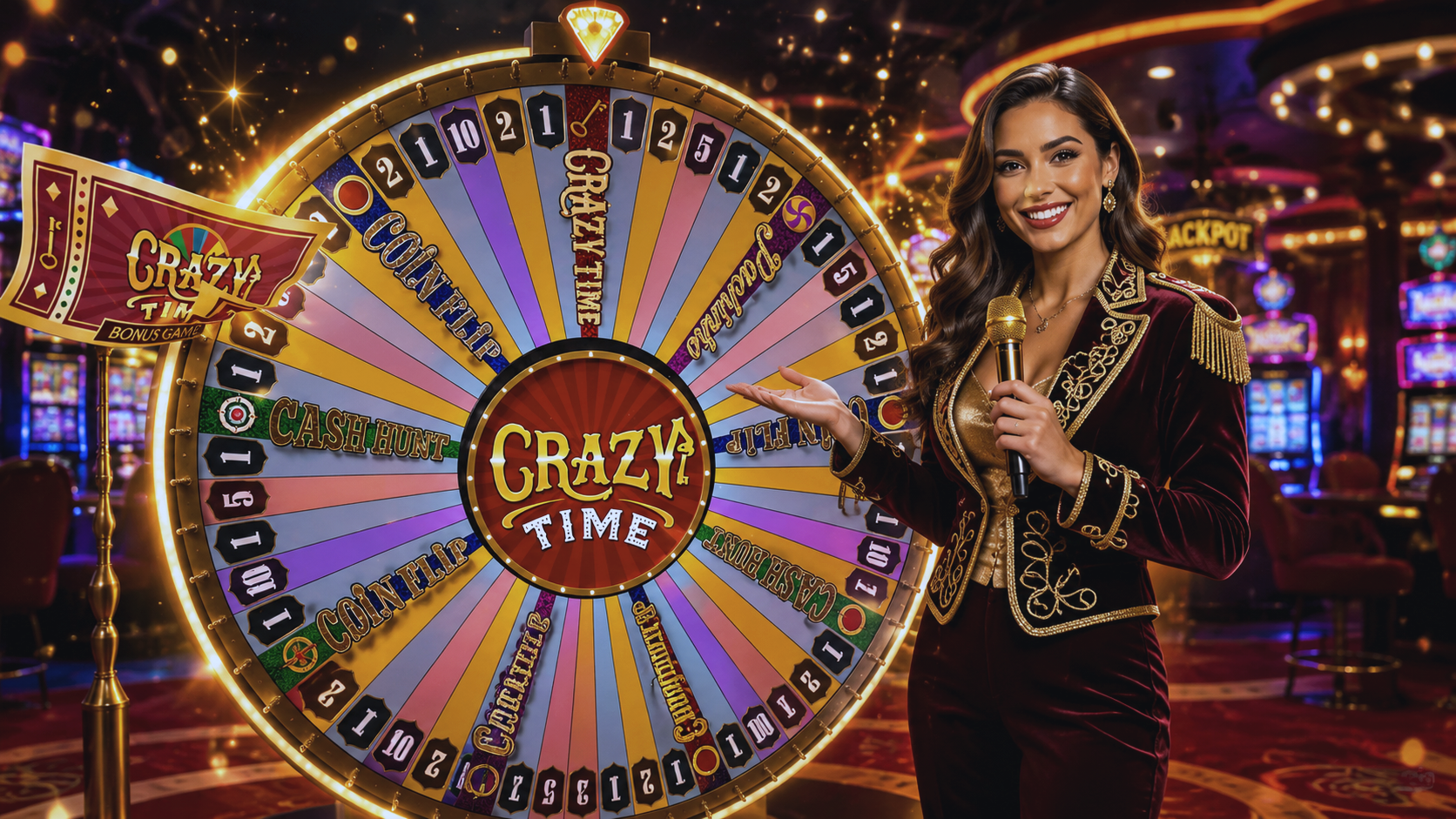
I’ll be honest — I avoided Crazy Time for longer than I should have.
Not because I thought it was bad. Because everything about it screamed designed for someone else. The oversized wheel, the neon studio, the hosts in sequined jackets bouncing around a set that looks like a game show from a parallel universe where casinos sponsor prime time television. It felt like spectacle engineered specifically for people who find regular casino games too quiet.
I was partially right about that. What I was wrong about is whether that makes it worth your time.
What You’re Actually Playing
Crazy Time is a live game show from Evolution Gaming built around a main money wheel with 54 segments. Those segments are distributed across four number outcomes — 1, 2, 5, and 10 — and four bonus rounds: Coin Flip, Cash Hunt, Pachinko, and the Crazy Time bonus itself.
Before each spin, a Top Slot above the main wheel spins independently. The left reel lands on one of the eight bet types, and the right reel lands on a multiplier between 2x and 50x, or misses. If the main wheel then lands on the same bet type, the win is boosted by that multiplier.
You place your bets on which segment you think the wheel will land on. The wheel spins. Something happens. That’s the game.
There’s no strategy. Unlike blackjack, there is no set way to play that improves the house edge or your chances. It’s completely random. If that sounds reductive — it is, and it isn’t. The absence of decision-making is partly what makes this game work as entertainment. You’re not here to think. You’re here to watch.
The Math, Quickly
The RTP of Crazy Time ranges between 94.41% and 96.08% depending on which segments you’re betting on, with an average of around 95.41% across all bets. The house edge varies between 3.92% and 5.59% depending on which sections players place bets on.
To put that in context: blackjack with basic strategy sits well below 1% house edge. Even a competitively priced slot runs around 4% house edge on average. Crazy Time, depending on your betting approach, can sit toward the higher end of that range.
Number 1 occupies 21 of the 54 segments. Number 2 has 13. Number 5 has 7. Number 10 has 4. The four bonus rounds each occupy 2 to 4 segments. The numbers are the high-frequency, low-return bets. The bonus rounds are the low-frequency, high-return bets. Players have roughly a 1 in 6 chance of landing a bonus round with each spin.
This is not a mathematically efficient game. It’s an entertainment product with a price attached to it. Going in knowing which one it is changes the experience considerably.
The Four Bonus Rounds
This is where the game earns its reputation. Each bonus round is a different format entirely — and the variance between them is significant.
Coin Flip is the simplest. A coin with a red and blue side flips, each side showing a multiplier. The winning side’s multiplier is applied to your bet. Fast, clean, over quickly. The lowest variance of the four.
Cash Hunt sends you to a screen covered in targets, each hiding a multiplier. You pick one. It reveals. You either feel clever or arbitrary — the outcome is random either way, but the act of choosing makes it feel participatory in a way that’s genuinely engaging even when you know it shouldn’t matter.
Pachinko drops a puck down a giant physical pegboard — not digital, an actual mechanical board — and it lands on a multiplier at the bottom. The ball’s journey is visible and genuinely unpredictable. Watching it ricochet toward a big number or drift away from it is more dramatic than it has any right to be.
The Crazy Time bonus is the one that justifies the game’s name. You enter a virtual wheel with multiplier segments and a special Crazy Time segment that can trigger a second spin. The maximum multiplier available in the Crazy Time bonus is 20,000 times your bet. Getting there requires the wheel to land on the right segment with the right Top Slot multiplier in play simultaneously. It happens. Not often. When it does, the studio reacts accordingly.
What a Session Actually Feels Like
I sat with Crazy Time across several sessions before forming a firm opinion. The first thing that struck me was the pace. The wheel spins every 30 to 45 seconds. You bet, you watch, the result is immediate, you bet again. Compared to a slot where you control the timing, Crazy Time has a rhythm that’s driven by the show rather than by you. Some players will find that relaxing. Others will find it frustrating when the wheel keeps landing on segments they didn’t bet on.
The hosts are a genuine differentiator. Not in a way I expected to care about, but they add something. The energy in the studio is consistent — not frantic, not mechanical — and the interaction between the hosts and the bonus rounds is polished in a way that Evolution has clearly invested in. A Pachinko drop with a host commentating the ball’s path in real time is a different experience from watching a slot animation play out in silence.
The sessions where I bet exclusively on number segments were steady and unremarkable. Frequent small returns, occasional nothing, the occasional number 10 hit that felt worthwhile. The sessions where I weighted toward bonus rounds were more volatile — longer stretches of missing, punctuated by bonus triggers that ranged from modest to genuinely exciting depending on what the Top Slot had applied going in.
The sweet spot, for what it’s worth, is treating the number bets as session maintenance and the bonus bets as the reason you’re there. The math doesn’t strongly favour either approach but the experience is better when you have something to actually wait for.
The Skeptical Part
I came into this game skeptical and I’m leaving with something more nuanced.
The production value is real. Evolution has built something that functions as genuine entertainment, not just a gambling mechanism dressed in a game show costume. The bonus rounds are varied enough to stay interesting across sessions. The Pachinko board in particular has a physical unpredictability that digital alternatives can’t quite replicate.
What I’m still skeptical about is the house edge relative to everything else in the live casino section. Crazy Time was built for thrills, not income, and that’s an accurate description — but it means you’re paying a premium in house edge for the entertainment value. Compared to live blackjack at under 1% with basic strategy, Crazy Time is a significantly more expensive form of entertainment per hour of play.
Whether that premium is worth it depends entirely on what you’re there for. If you want to feel like you’re playing a game with real decisions and real strategic input, Crazy Time isn’t that. If you want to watch a wheel spin in a studio that looks like it costs more per square metre than most apartments, while a host narrates a ball bouncing toward a multiplier you’re genuinely hoping for — Crazy Time delivers that better than anything else in the lobby.
I went in skeptical. I came out entertained. The math didn’t change, but the experience was more honest about what it was than I expected.
Gambling is entertainment with a cost attached, so set limits before you play and visit our Responsible Gaming page for support resources, safer-play tools, and help options if gambling stops feeling fun.

Leave a Comment