
Mega Moolah: The Biggest Progressive Jackpot in Any Lobby. Here’s What You’re Actually Playing.
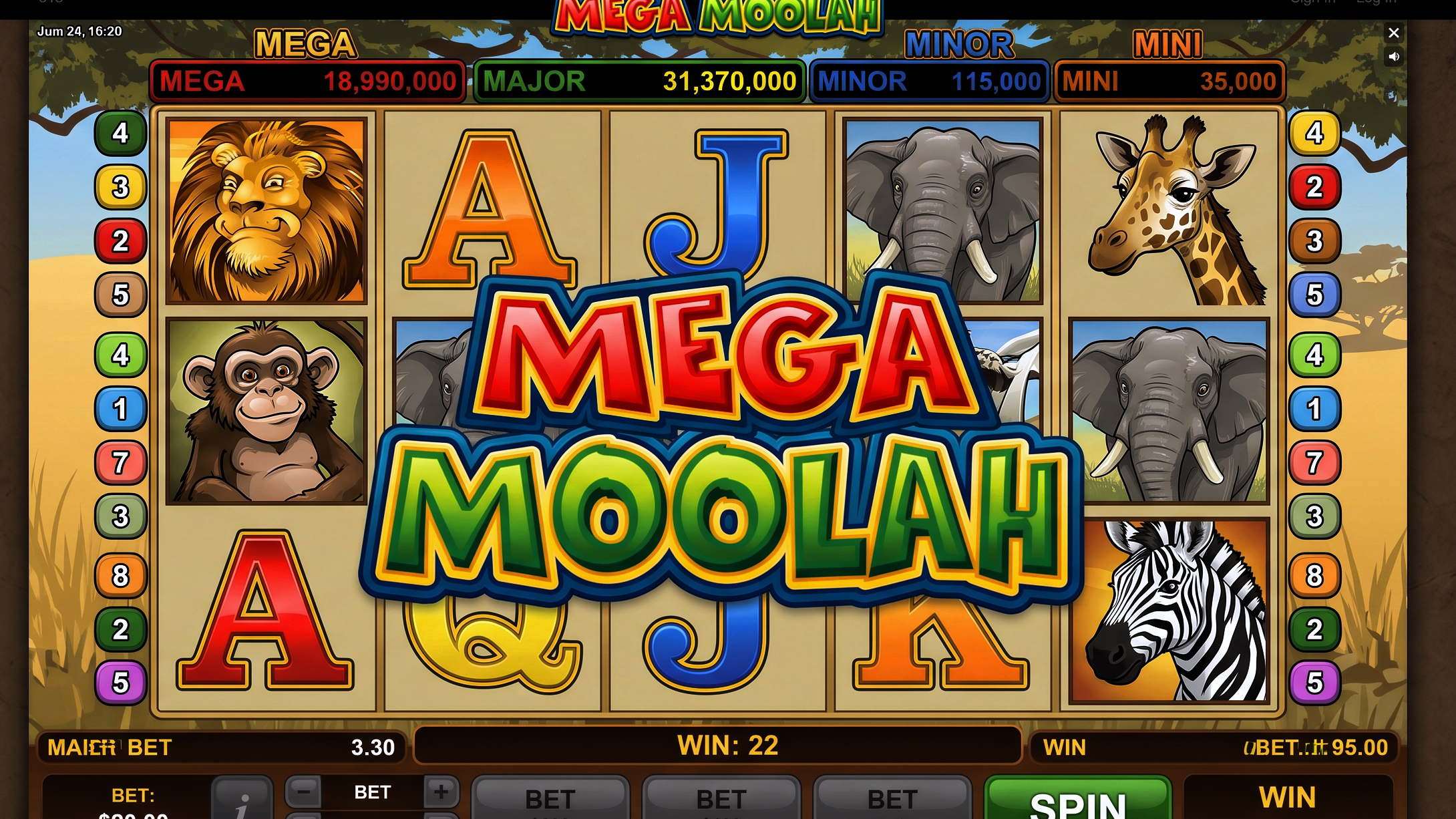
Mega Moolah has paid out more progressive jackpot money than any other online slot in history. That sentence does most of the marketing work on its own. It’s also the reason most players never look past the jackpot ticker to examine what they’re actually playing when they load the game. The jackpot is real. The question is whether the game underneath it deserves your session budget while you wait for a wheel spin that almost certainly isn’t coming.
That’s not cynicism. It’s arithmetic. Mega Moolah is a low-RTP, high-volatility slot where a meaningful portion of every bet feeds a prize pool you have a roughly one-in-fifty-million chance of winning. The base game exists, and it has features, but it was never designed to be the point. Understanding what you’re actually paying for changes how you approach the session entirely.
Here’s what the jackpot ticker doesn’t show you.
What the Game Actually Is
Mega Moolah is a five-reel, 25-payline progressive jackpot slot developed by Microgaming (now operating under the Games Global umbrella). It launched in 2006 and has barely changed since. The African safari theme, the cartoon animal symbols, the interface design. It all looks like a product of its era because it is one. That’s not necessarily a problem, but it sets expectations correctly: this is not a modern slot experience.
The published RTP is 88.12%. That number stops most experienced players cold, and it should get your attention. For context, the industry standard for modern slots sits between 95% and 96.5%. The gap exists because a portion of every wager feeds the progressive jackpot pool. Microgaming has historically cited an “effective” RTP closer to 93-94% when jackpot contributions are factored back in, but that figure only materialises across millions of spins and includes the massive outlier payouts that one player receives and millions don’t. For your individual session, 88.12% is the operative number.
Volatility is high. The base game pays infrequently and in small amounts relative to bet size. That’s by design. The game’s architecture directs value toward the jackpot mechanism, not the regular paytable.
The Jackpot Wheel Is the Entire Point
Mega Moolah’s signature feature is the randomly triggered jackpot bonus wheel. There’s no specific symbol combination required. Any spin, at any bet level, can trigger the wheel. Higher bets increase the probability of triggering it, but Microgaming has never published the exact trigger rates. What’s known is that the wheel offers four jackpot tiers: Mini (starts at $10), Minor (starts at $100), Major (starts at $10,000), and Mega (starts at $1,000,000).
The Mega jackpot is the one that makes headlines. It’s hit for over $20 million on multiple occasions. The largest verified payout was approximately $23.6 million CAD in 2018. These are real payouts to real players. They’re also extraordinarily rare events. The Mega jackpot typically hits every 8 to 12 weeks on average, but that’s across the entire global player pool spinning on the game simultaneously. Your individual odds of being the player who triggers it on any given spin are vanishingly small.
When the wheel does trigger, most players land on Mini or Minor. The wheel isn’t weighted equally across tiers, and the Mega slice is the smallest segment. Getting to the wheel is the hard part. Landing on Mega once you’re there is another layer of improbability.
The Free Spins Feature Exists, but It’s an Afterthought
Three or more scatter symbols (the monkey, if you’re wondering) trigger 15 free spins with a 3x multiplier. It can retrigger during the feature. On paper, that sounds reasonable. In practice, the base game paytable is thin enough that even tripled wins rarely produce significant returns. I’ve seen enough Mega Moolah sessions documented to know the free spins round typically returns somewhere between 5x and 20x the triggering bet. Occasionally more. Rarely enough to reshape a session.
The wild symbol (the lion) substitutes for everything except scatters and doubles any win it completes. It’s the most valuable base game element, but it doesn’t change the fundamental reality: the regular game mechanics are functional but unremarkable. They exist to keep the reels spinning between jackpot wheel triggers that may never come.
What It Costs to Play It Properly
The minimum bet is $0.25 per spin (one coin per line across 25 lines). The maximum is $6.25 per spin. Since higher bets increase jackpot trigger probability, there’s an inherent tension: the game incentivises larger bets, but the 88.12% RTP means your bankroll erodes faster at higher stakes than it would on almost any other slot in the lobby.
At $0.25 per spin, playing 600 spins per hour (a moderate pace), you’re cycling $150 per hour through a game that returns roughly 88 cents on every dollar over time. That’s a theoretical cost of about $18 per hour. At the maximum $6.25 per spin, the same pace puts $3,750 through the game per hour with a theoretical cost of roughly $445. Those numbers matter because Mega Moolah sessions tend to run cold. The base game doesn’t sustain your balance the way a 96% RTP slot does.
A realistic session budget for Mega Moolah at minimum stakes is $50 to $75 CAD. That gives you roughly 200 to 300 spins before the math catches up. At mid-range stakes ($1.25 per spin), budget $100 to $150 CAD and expect a shorter session. If you’re playing for the jackpot experience, set a hard loss limit and treat the session cost as entertainment spending, not an investment.
The RTP Question Nobody Asks
Most players accept the low RTP because “the jackpot makes up for it.” That framing deserves scrutiny. The jackpot contribution does technically raise the long-term theoretical return, but the value is concentrated in a single payout that one player receives while millions absorb the cost. It’s structurally identical to a lottery ticket embedded inside a slot machine. The base game is the ticket price. The jackpot is the draw.
This isn’t a flaw. It’s the product. But it means comparing Mega Moolah’s RTP to a standard slot is misleading in both directions. It’s worse than a 96% slot for session sustainability. It’s potentially better if you happen to be the statistical outlier who hits the Mega. The honest framing is that you’re paying a premium on every spin for a lottery entry, and the base game experience is the cost of that entry, not a standalone entertainment product.
It’s also worth noting that some operators may run different RTP configurations. Check the game’s info screen or help section at whatever site you’re playing. If the listed RTP is lower than 88.12%, you’re paying even more per spin for the same jackpot odds.
Who It’s For
Mega Moolah suits a specific type of player: someone who wants the progressive jackpot experience, understands the cost, and treats the session as a fixed-budget lottery with a slot machine attached. If you enjoy the anticipation of a random jackpot trigger and you’re comfortable with long cold stretches and minimal base game engagement, the game delivers exactly what it promises.
It does not suit players who want session value, frequent wins, engaging bonus mechanics, or modern game design. If you typically play slots for the feature rounds, the free spins here will disappoint you relative to almost any modern title. If you evaluate games primarily on RTP, Mega Moolah will never make your shortlist. And if you’re on a tight budget, the low return rate will shorten your sessions noticeably compared to higher-RTP alternatives.
Honest Assessment
Mega Moolah is the most famous progressive jackpot slot in the world, and it earns that status through verified, life-changing payouts that no other game has matched in frequency or scale. That’s the product. The base game is dated, the RTP is the lowest you’ll find in most lobbies, and the free spins feature is forgettable. None of that is hidden, but none of it is emphasised in the marketing either.
The honest verdict is that Mega Moolah is a good progressive jackpot delivery system and a below-average slot. If you want both, you’ll need to look at newer progressives that offer better base game mechanics alongside their jackpot pools. If you want the original, the biggest, the one with the track record, this is it. Just know what you’re buying with every spin. The game doesn’t owe you a jackpot, and the base game isn’t designed to make the wait comfortable.
The jackpot counter at the top of the screen is doing its job. It keeps your eyes on the number that grows and away from the number that matters more: the 88.12% return rate that defines every session where the wheel doesn’t land on Mega. Play it if the jackpot dream is worth the session cost. Skip it if you want your bankroll to last.
Gambling is entertainment with a cost attached, so set limits before you play and visit our Responsible Gaming page for support resources, safer-play tools, and help options if gambling stops feeling fun.

Leave a Comment