
Sugar Rush 1000 vs. Jammin’ Jars 2: Same Format, Two Very Different Sessions
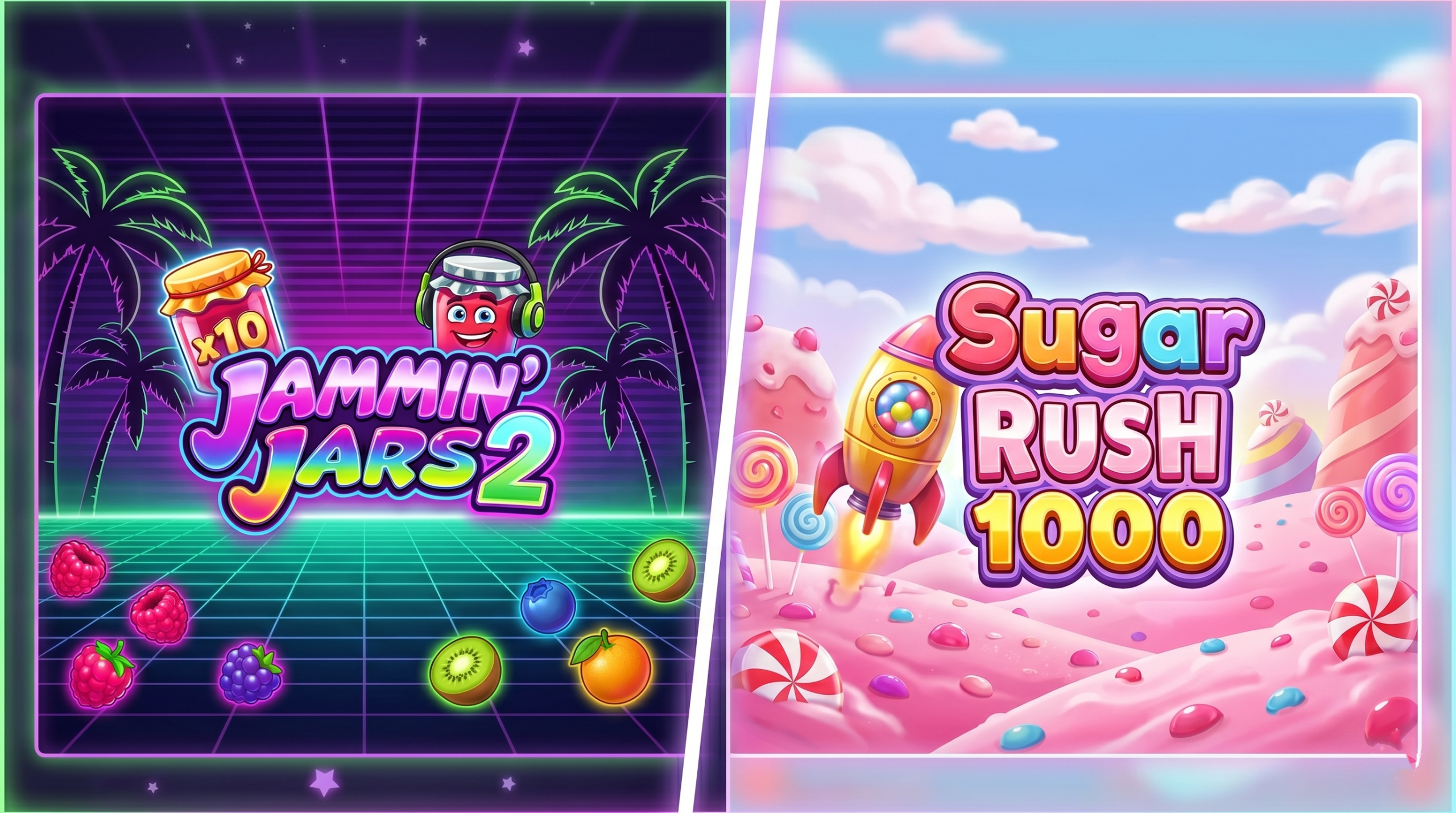
Both games put you on a large grid filled with colourful symbols. Both use cluster pays — wins form when enough matching symbols connect anywhere on the board rather than along fixed lines. Both tumble winning symbols off the grid and replace them, giving you the chance to chain multiple wins from a single spin. Both look cheerful, run at competitive RTPs, and have loyal followings.
On paper they’re close cousins. In practice, they feel nothing alike.
I’ve spent enough time with both to have a clear picture of what each game actually delivers session to session, and the differences are sharper than the shared format suggests. Here’s the honest breakdown.
The Format They Share — and Where It Ends
Cluster pays on a large grid is genuinely one of the more player-friendly slot formats available right now. No paylines to track, no left-to-right requirement, just symbols connecting wherever they land. The cascade mechanic means a strong spin can deliver several consecutive wins as clearing symbols make room for new ones to fall.
That shared foundation creates a similar rhythm at the start of any session with either game. You spin, clusters form or don’t, the grid refreshes, you go again. The base game on both has a certain meditative quality — especially at lower stakes where you’re not chasing specific outcomes, just watching what the grid does.
Where Sugar Rush 1000 and Jammin’ Jars 2 diverge is in how the variance is structured, what the bonus round actually does, and what the session experience feels like once things start moving.
Sugar Rush 1000: The Multiplier Machine
Pragmatic Play released Sugar Rush 1000 in March 2024 as the follow-up to the original Sugar Rush, and the headline upgrade is exactly what the name suggests. The max win has been pushed to 25,000 times your stake, up from 5,000 in the original, and the multiplier spots that drive it can now reach 1,024x per position on the grid.
The multiplier spot system is the mechanic worth understanding before you play. Certain grid positions become active when winning clusters land on them. Each time a subsequent cluster lands on the same position, the multiplier at that spot doubles. In the free spins round, those spots are persistent — they carry and compound across every spin of the feature. A grid where several high-multiplier positions are active simultaneously, each doubling with every cluster that hits them, is how the game’s ceiling becomes reachable.
The RTP sits at 96.53% in its standard configuration, with some operators running it as high as 97.5%. It’s worth checking which version is active at whichever platform you’re using.
The session experience is colourful, fast, and relentlessly cheerful. The candy aesthetic is unapologetically bright. What sits underneath it is a genuinely high-variance game that requires the multiplier positions to stack before the free spins round delivers anything dramatic. Getting there takes patience. When it runs hot, the cascade chains and compounding multipliers produce a visual spectacle that justifies the waiting.
Jammin’ Jars 2: The Progression Game
Push Gaming released Jammin’ Jars 2 in June 2021, three years before Sugar Rush 1000, and the design philosophy is meaningfully different despite the shared format.
The 8×8 grid is larger than Sugar Rush 1000’s 7×7, which gives it more room for clusters to form and cascade. The visual identity is neon disco rather than candy shop — fruit symbols in vivid colours against a nightclub backdrop, with a Giga Jar DJ character sitting to the left of the grid.
That DJ is the game’s most distinctive element. As you play, Gold Vinyl symbols land and feed a progress meter attached to the Giga Jar. The meter advances through five levels, and at each level the RTP increases incrementally — from 96.1% at level one to 96.6% at maximum level. Reaching the maximum level also unlocks the Giga Jar feature, the game’s standout bonus round.
This progression system is the most unusual aspect of Jammin’ Jars 2, and it changes how the game feels to play in a fundamental way. You’re not just waiting for a scatter trigger. You’re accumulating something. The Giga Jar meter gives the session a building quality that a standard free spins trigger doesn’t. When the Giga Jar finally fires — clearing the grid, adding Wild Jars, and delivering eight Giga Spins with the DJ landing as a large instant prize block — the payoff feels earned in a way that a random bonus trigger doesn’t quite replicate.
The max win potential sits at 50,000 times stake, double Sugar Rush 1000’s ceiling. The RTP at max level is competitive. The volatility is high, with the Giga Jar feature requiring substantial vinyl collection before it becomes available.
What They Feel Like Head to Head
I’ve played extended sessions on both and the contrast in session texture is the most useful thing I can tell you.
Sugar Rush 1000 is the more immediately intense experience. The multiplier spots activate early and the free spins round can move quickly from trigger to outcome. Sessions tend to be defined by the free spins feature — either the multipliers compound into something significant or they don’t, and the base game between triggers is the cost of finding out. It’s a game that rewards players who can handle streaky base game play without losing patience.
Jammin’ Jars 2 has a longer arc. The Gold Vinyl collection gives you something to work toward across the session, which makes the base game feel more purposeful than passive. The Giga Jar feature, when you finally earn it, is one of the more dramatically satisfying bonus rounds I’ve played on a cluster pays slot. The downside is that earning it takes time, and at lower stake levels that time extends considerably.
If I’m planning a shorter session and want a game that can deliver something significant in a compact window, Sugar Rush 1000 is the better choice. If I have more time, more budget, and want the session to build toward something, Jammin’ Jars 2 is the more rewarding experience.
The RTP Check Worth Doing First
Both games have variable RTP configurations that operators can choose between. Sugar Rush 1000 runs as high as 97.5% at certain operators, but many platforms use the 96.53% version or lower. Jammin’ Jars 2 has its own range, with the base RTP starting lower and climbing as you progress through Gold Vinyl levels.
On either game, checking the information panel before you play is worth thirty seconds of your time. The game’s mechanics are identical regardless of which RTP version the operator is running, but the math underneath changes enough to affect long session performance in a meaningful way.
Which One Is Worth Your Time
They’re both genuinely good cluster pays slots and both deserve their reputations. Sugar Rush 1000 is the flashier, more immediate experience with a lower max win ceiling but a faster route to the moments that define a session. Jammin’ Jars 2 asks for more commitment and rewards it with a progression mechanic that makes the experience feel more layered than most slots in the same format.
The question isn’t which one is better. It’s which kind of session you’re actually in the mood for.
Gambling is entertainment with a cost attached, so set limits before you play and visit our Responsible Gaming page for support resources, safer-play tools, and help options if gambling stops feeling fun.


Leave a Comment