
Immortal Romance vs. Thunderstruck II: Two Microgaming Legends. One Aged Better Than the Other.
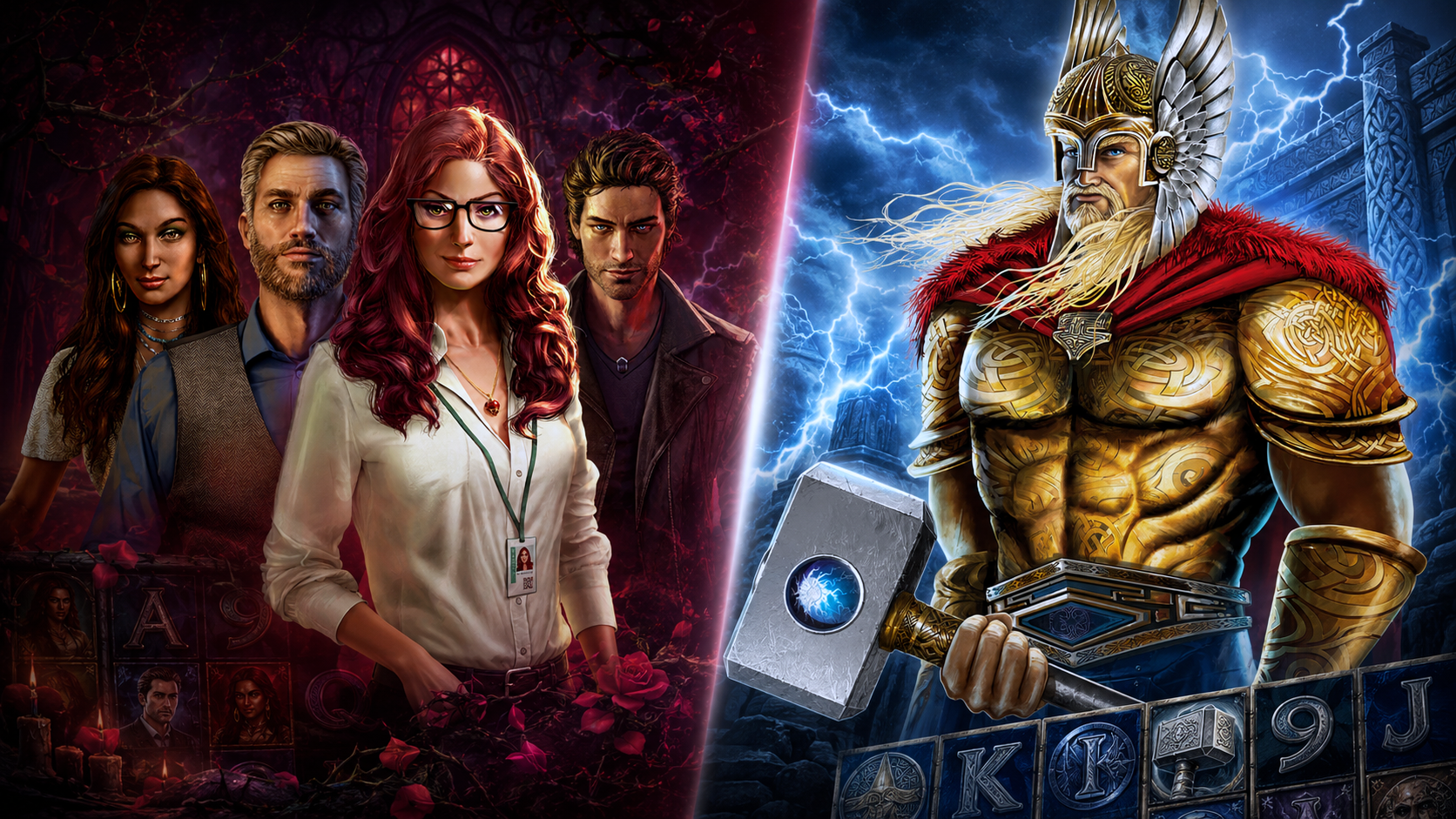
If you’ve spent any time in a Canadian casino lobby running Games Global titles, you’ve seen both of these games near the top. Immortal Romance and Thunderstruck II sit in a category that barely exists anymore: slots old enough to have a genuine legacy, still prominent enough that new players discover them every week. They share a developer, a multi-tier free spins system, and a 243-ways-to-win payline structure. On paper, they’re siblings.
In practice, they’ve aged in completely different directions. One of them still delivers a session experience that justifies its lobby placement. The other survives mostly on name recognition and the fact that casinos keep featuring it in welcome bonus lists. The difference isn’t in the theme or the graphics. It’s in the bonus architecture and what it actually costs you to reach the parts of each game that matter.
I’ve played enough sessions on both to have a clear view on which one earns its spot. Here’s the comparison stripped down to the mechanics that actually affect your balance.
The Shared Blueprint: 243 Ways and a Tiered Free Spins System
Both games use the 243-ways-to-win structure that Microgaming popularised in the late 2000s. No traditional paylines. Any matching symbol on adjacent reels from left to right pays. This means every spin covers the same number of potential combinations regardless of bet level, which simplifies the math but also means you can’t reduce your exposure by playing fewer lines.
The defining shared mechanic is the multi-tier bonus system. Both games lock their best free spins features behind a progression wall. You don’t get the top-tier bonus the first time you trigger free spins. You need to trigger the feature multiple times across your session, sometimes across multiple sessions, to unlock the higher tiers. Thunderstruck II has four tiers (Valkyrie, Loki, Odin, Thor). Immortal Romance has four as well (Amber, Troy, Michael, Sarah). The first trigger gives you tier one. The second gives you tier two. And so on.
This is the mechanic that defines both games. And it’s where the comparison gets interesting, because the tiers are not equally valuable, and the two games handle the progression very differently in terms of what each tier actually delivers.
Thunderstruck II’s Tier Problem
Thunderstruck II’s first-tier bonus is the Valkyrie feature: 10 free spins with a 5x multiplier. It’s functional. It can pay. But it’s the baseline, and it feels like one. The second tier, Loki, gives you 15 free spins with a Wild Magic feature that adds extra wilds. Tier three, Odin, offers 20 free spins with a wild raven that doubles or triples wins. The top tier, Thor, delivers 25 free spins with Rolling Reels where the multiplier increases with consecutive wins up to 5x.
The Thor feature is genuinely good. The rolling reels with escalating multipliers can produce the kind of sequences that justify the game’s reputation. The problem is reaching it. You need to trigger the bonus feature four separate times before you unlock Thor. At medium volatility with an RTP of 96.65%, the bonus triggers aren’t frequent enough to make that a reliable part of a single session. I’ve seen sessions where the third trigger doesn’t arrive inside 300 spins. That means you’re often playing through the weaker tiers repeatedly, and the Valkyrie feature in particular feels like a participation trophy after the investment required to trigger it.
The game essentially front-loads its weakest content. Your first bonus experience with Thunderstruck II is its least impressive one, which is a strange design choice for player retention.
Immortal Romance’s Smarter Progression
Immortal Romance uses the same four-tier unlock system, but the distribution of value across those tiers is more balanced. The Amber feature (tier one) gives you 10 free spins with a 5x multiplier, similar to Thunderstruck II’s Valkyrie. But the Troy feature (tier two) offers 15 free spins with Vampire Bats that turn symbols wild with up to a 6x multiplier. The Michael feature (tier three) delivers 20 free spins with Rolling Reels and increasing multipliers up to 5x. The Sarah feature (tier four) provides 25 free spins with Wild Vine, a mechanic that can turn entire reels wild.
Here’s the key difference: Immortal Romance’s second and third tiers are genuinely strong. The Troy feature with its random wild transformations can produce substantial payouts. The Michael feature’s rolling reels are comparable to what Thunderstruck II saves for its fourth tier. So even if you never reach the Sarah feature in a given session, you’re still accessing meaningful bonus content by your second or third trigger.
Immortal Romance also has the Wild Desire feature, which can randomly trigger during any base game spin and turn up to five reels completely wild. It’s rare, but it adds a layer of base game tension that Thunderstruck II simply doesn’t have. The base game in Thunderstruck II, once you’ve been through a cold stretch, feels static. Immortal Romance’s base game has a pulse.
RTP, Volatility, and What a Session Actually Costs
Thunderstruck II publishes an RTP of 96.65%. Immortal Romance sits at 96.86%. The difference is small in isolation, but over a long session at $1.50 per spin (a common bet level for 243-ways games where the minimum is typically $0.30), that gap compounds. Both are medium volatility according to their provider data, but Immortal Romance plays slightly more volatile in practice because the Wild Desire feature and the stronger mid-tier bonuses create wider variance in session outcomes.
A realistic session budget for either game at $0.30 per spin is around $60 to $90 for 200 to 300 spins, which should give you a reasonable chance at two or three bonus triggers. At $1.50 per spin, you’re looking at $300 to $450 for the same spin count. The important note: some operators run these games at lower RTP configurations. Games Global titles can be set at multiple RTP levels. Always check the info screen or paytable within the game itself to confirm you’re playing the published version.
Neither game is cheap to play properly if your goal is reaching the upper bonus tiers. But Immortal Romance rewards you more meaningfully along the way, which changes the feel of the session even when the math is similar.
The Theme Question (It Matters Less Than You Think)
Thunderstruck II leans into Norse mythology. Immortal Romance goes with gothic vampire romance. Both themes were distinctive when these games launched. In 2024, Norse mythology slots outnumber original ideas in most lobbies by a wide margin, and Thunderstruck II’s visual presentation, while updated, doesn’t stand out the way it once did. Immortal Romance’s darker, more narrative-driven aesthetic still feels like it belongs to its own category. The character introductions, the story elements woven into the bonus triggers, the atmospheric soundtrack. These elements age better than lightning bolts and hammers.
But theme is cosmetic. It doesn’t change the math or the mechanics. If you’re choosing between these two games based on whether you prefer vampires or Vikings, you’re making the decision at the wrong level. The session experience is where the real difference lives.
Who Each Game Is Actually For
Thunderstruck II suits the player who’s willing to grind through weaker bonus rounds for the promise of the Thor feature. If you’re the type who plays long sessions, doesn’t mind flat stretches, and treats the early triggers as progress markers rather than payoff moments, the game still delivers when it finally opens up. It’s a patience game. The problem is that patience costs money, and the early tiers don’t return enough to sustain a session that’s running cold.
Immortal Romance suits a broader range of session styles. Short sessions benefit from the Wild Desire random feature. Medium sessions get value from the Troy and Michael tiers. Long sessions eventually unlock Sarah, which is one of the better top-tier bonus rounds in the Games Global catalogue. It’s a game that gives you something at almost every stage of a session, which is a fundamentally better design for how most people actually play.
Honest Assessment
Thunderstruck II is the more famous game. It’s featured in more welcome bonus packages, it appears higher in more lobby rankings, and its name carries more weight with players who remember Microgaming’s golden era. But fame isn’t the same as quality, and in a direct mechanical comparison, Immortal Romance is the better-designed slot. Its bonus tiers distribute value more evenly, its base game has more tension, its RTP is marginally higher, and its session feel rewards a wider range of play styles.
Thunderstruck II isn’t a bad game. It’s a game that puts too much of its value behind a wall that most sessions won’t reach. Immortal Romance understood that the journey to the top tier needs to be worth playing on its own terms. That’s the difference between a game that aged into a classic and one that aged into a legacy act. If you’re choosing one for your next session, Immortal Romance is the pick. It’s not close.
Both of these games will keep appearing in Canadian casino lobbies for years. They’ve earned that. But earning a lobby spot and earning your time are different things, and only one of them still does both. The next time a welcome bonus steers you toward Thunderstruck II, check whether Immortal Romance is available under the same terms. If it is, that’s your session.
Gambling is entertainment with a cost attached, so set limits before you play and visit our Responsible Gaming page for support resources, safer-play tools, and help options if gambling stops feeling fun.

Leave a Comment