
Your Casino Withdrawal Has a Pending Period. Here’s What Actually Happens During It.

You hit the withdrawal button and something happened. The casino confirmed it. A notification appeared. Maybe an email landed. And then nothing. Your balance dropped, but the money didn’t arrive. It’s sitting in a state the industry calls “pending,” and that word does a remarkable amount of work to disguise what’s actually going on behind it.
The pending period is where most of the friction in online casino withdrawals actually lives. It’s not a processing delay in the way your bank processes a transfer. It’s a window the casino has built into its cashier system, and what happens inside it varies wildly depending on the operator, the amount, and whether your account has been verified. Most players treat it as dead time. It isn’t.
Understanding what the pending period actually is, and what the casino is doing during it, changes how you approach withdrawals entirely. It also explains why some casinos pay out in hours and others take days for the same amount through the same payment method.
The Pending Period Is a Casino-Side Hold, Not a Transfer Delay
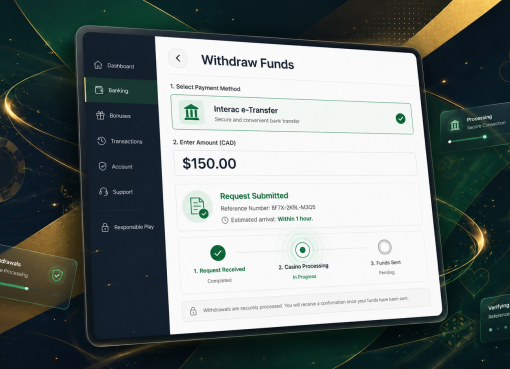
When you request a withdrawal, the money doesn’t leave the casino. It moves from your playable balance into a holding state controlled entirely by the operator. The casino sets the rules for how long this state lasts, and those rules are buried in the terms and conditions, not displayed on the cashier page.
Pending periods typically range from 24 to 72 hours at most operators available to Canadian players, though some grey-market platforms stretch this to five or even seven days. Provincially regulated operators in Ontario tend to process faster, often within 24 hours, partly because iGaming Ontario’s standards create pressure to keep withdrawal times competitive. But “pending” and “processing” are two different stages, and operators aren’t always transparent about which one you’re in.
The key distinction: the pending period is entirely within the casino’s control. Once it ends and the withdrawal is approved, the transfer to your Interac e-Transfer, bank account, or e-wallet follows the payment provider’s timeline. That second stage is usually fast and predictable. The first stage is where the uncertainty lives.
What the Casino Is Actually Doing During That Window
Casinos don’t publish a checklist of what happens during the pending period, but the process generally involves a few things happening simultaneously. The first is a basic fraud and security review. The system checks whether the withdrawal method matches the deposit method, whether the account shows unusual patterns, and whether the amount triggers any internal thresholds.
The second is bonus compliance. If you played with a bonus at any point, the system checks whether wagering requirements were completed, whether max bet rules were respected during bonus play, and whether the withdrawal amount exceeds any maximum win cap tied to the promotion. This is where withdrawals get cancelled or reduced without warning, and it’s the single most common reason a pending withdrawal doesn’t convert to an approved one.
The third is KYC verification. If you haven’t completed identity verification before your first withdrawal, the pending period is when the casino flags your account and requests documents. This can extend the pending window from 48 hours to a week or more, depending on how quickly you respond and how fast the compliance team reviews. I’ve seen enough of these delays to know the pattern: complete your KYC before you ever request a withdrawal, and this stage disappears.
The Reversal Button Exists for a Reason
Here’s the part that matters most, and the part casinos are least interested in explaining clearly. During the pending period, many operators give you the option to cancel the withdrawal and return the funds to your playable balance. Some make this easy. Some make it very easy. A prominent “Cancel Withdrawal” button sitting right there in your cashier, sometimes accompanied by a prompt asking if you’re sure you want to wait.
This is not a consumer-friendly feature. It’s a retention mechanism. The longer the pending period, the longer that reversal button is available, and the more likely a player is to cancel the withdrawal and keep playing. Operators know this. The data on reversal rates is one of the metrics casino platforms track closely, and a longer pending window correlates directly with higher reversal rates.
Some provincially regulated operators have moved to eliminate or shorten the reversal window. Others have removed the cancel button entirely once a withdrawal enters processing. If you’re evaluating a casino and want to know how player-friendly it actually is, the reversal policy tells you more than the welcome bonus ever will.
Why Interac Withdrawals Still Aren’t Instant
Canadian players who deposit with Interac e-Transfer are used to instant deposits. The money leaves your bank and hits your casino balance in seconds, sometimes less. So when the withdrawal takes two to four business days, the assumption is that Interac is slower on the way out. That assumption is wrong.
Interac e-Transfer itself processes quickly in both directions. The delay is almost entirely on the casino side. The pending period, the internal review, the KYC check if it hasn’t been done. Once the casino actually releases the funds, the Interac transfer typically completes within hours, often the same business day. The gap between “I requested a withdrawal” and “the money arrived” is dominated by the casino’s internal timeline, not the payment provider’s.
This is worth knowing because it changes where you direct your frustration and, more importantly, your questions. If a withdrawal has been pending for 72 hours, contacting Interac won’t help. Contacting the casino’s support team and asking specifically whether the withdrawal has been approved and released to the payment provider will tell you exactly where the hold-up is.
Large Withdrawals Get a Different Process
Most casino terms include a clause about maximum withdrawal amounts per day, per week, or per month. Common thresholds at operators serving Canadian players are $5,000 per day or $10,000 to $20,000 per week, though these vary significantly. When a withdrawal exceeds these limits, the casino splits it into instalments, and each instalment goes through its own pending period.
A $15,000 withdrawal at a casino with a $5,000 daily limit doesn’t arrive in three days. It arrives in three separate payments, each with its own pending window. If the pending period is 48 hours, you’re looking at a minimum of six days before the full amount clears, assuming no additional review is triggered by the size of the request.
Progressive jackpot wins and large bonus payouts often trigger enhanced due diligence, which adds another layer. The casino may request additional documentation, source-of-funds verification, or manual review by a senior compliance officer. These aren’t unreasonable steps, but they’re rarely explained upfront. The terms say “additional verification may be required for larger withdrawals,” which tells you almost nothing about what that actually looks like in practice.
How to Shorten the Wait Before It Starts
You can’t control the casino’s internal review timeline, but you can eliminate the most common reasons it gets extended. Complete KYC verification as soon as you open your account, before you ever make a withdrawal request. Upload your ID, proof of address, and payment method confirmation early. Every day you wait is a day that gets added to your first withdrawal.
Use the same payment method for deposits and withdrawals. Mismatched methods trigger additional checks. If you deposited with Interac e-Transfer, withdraw to Interac e-Transfer. If the casino doesn’t offer Interac for withdrawals, that’s information you should have before you deposit, not after you try to cash out.
Check the withdrawal limits and pending period before you play. These are published in the terms, usually under “Banking” or “Withdrawals.” A casino with a 24-hour pending period and a $10,000 weekly limit is a fundamentally different experience from one with a 72-hour pending period and a $4,000 weekly limit, even if the game library and bonus offer look identical.
Honest Assessment
The pending period is the single most revealing feature of any online casino’s cashier system. It tells you how the operator thinks about your money once you’ve asked for it back. A short pending window with no reversal button signals an operator that’s confident in its product and doesn’t need to trap funds. A long pending window with a prominent cancel button signals the opposite, regardless of how polished the lobby looks.
Canadian players have better options now than they did five years ago, particularly in Ontario where regulated operators face competitive pressure to process withdrawals faster. But the pending period remains the least transparent part of the withdrawal process, and the part most likely to catch a new player off guard. Knowing what it is and what’s happening inside it won’t make the wait shorter, but it will tell you whether the wait is reasonable or whether the casino is using your patience as a business model.
The withdrawal button feels like the end of a transaction. It’s actually the beginning of a different one, governed by rules you agreed to when you signed up and probably didn’t read. The casinos that process quickly aren’t doing you a favour. They’re just not using the pending period as a tool. That distinction is worth more than any bonus offer.
Gambling is entertainment with a cost attached, so set limits before you play and visit our Responsible Gaming page for support resources, safer-play tools, and help options if gambling stops feeling fun.


Leave a Comment