
Three Card Poker vs. Blackjack: One of These Games Cares What You Do
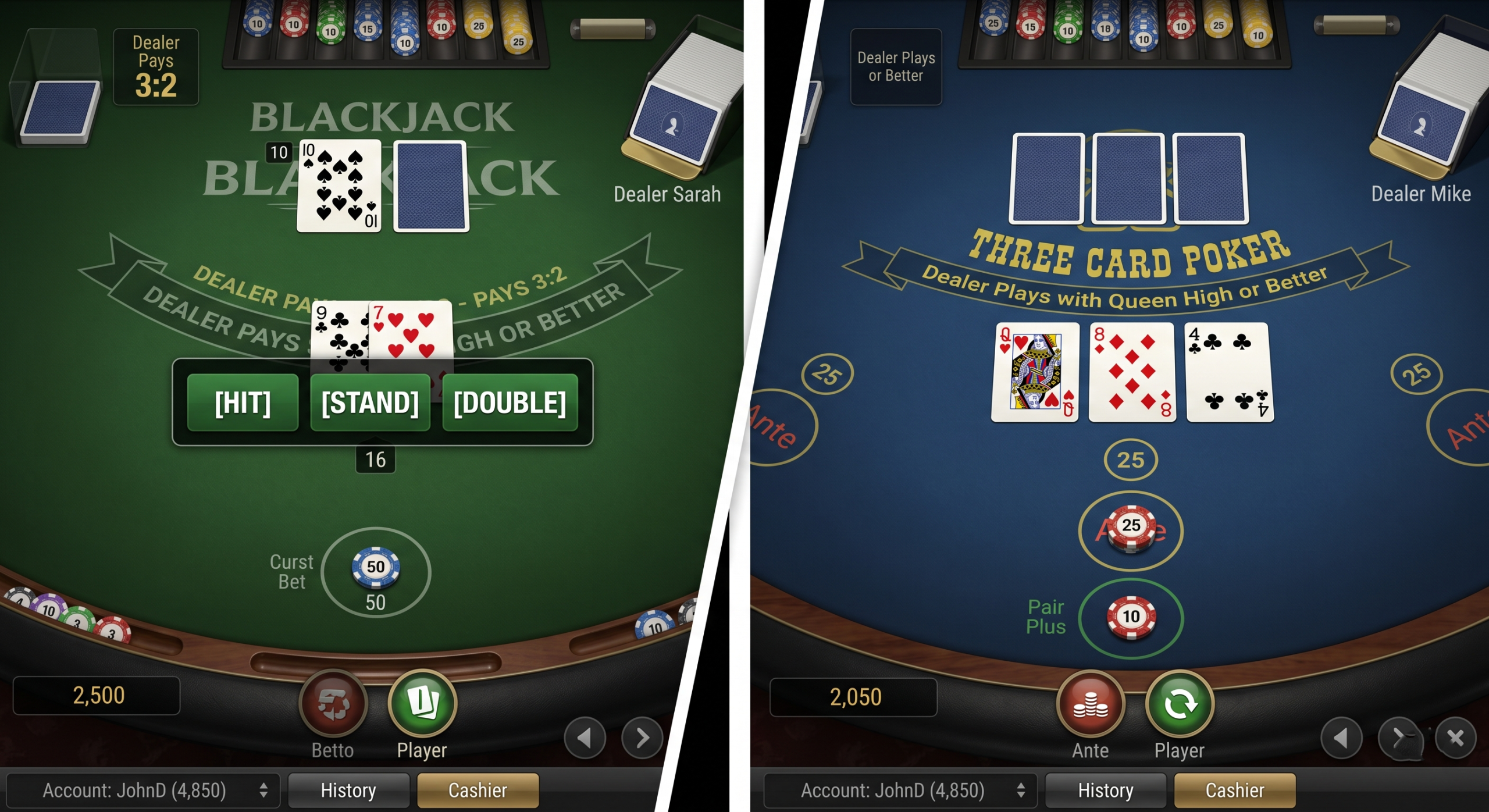
Both games sit in the table section of almost every online casino. Both look approachable. Both feel like a step up from slots for players who want something with more texture.
But they are not the same kind of game, and that difference matters more than most casino sites bother to explain.
Here’s the version nobody puts in the FAQ.
The Core Difference Nobody States Clearly
Blackjack is a skill game. Not in a “beat the system” sense, because the house always has an edge. But in a very real sense: the decisions you make at the table directly affect your results. Which cards you hit on, which you stand on, when you double down, when you split pairs. These choices have mathematically correct answers, and playing them right reduces the house edge significantly.
Three Card Poker is not that. You’re dealt three cards, you decide whether to play or fold, and then the dealer’s hand determines what happens. There’s one decision point and it has a simple rule attached to it. After that, the outcome is entirely out of your hands.
Neither approach is better in some absolute sense. But they are fundamentally different experiences, and knowing which one you’re sitting down to play matters.
The Blackjack Math, Quickly
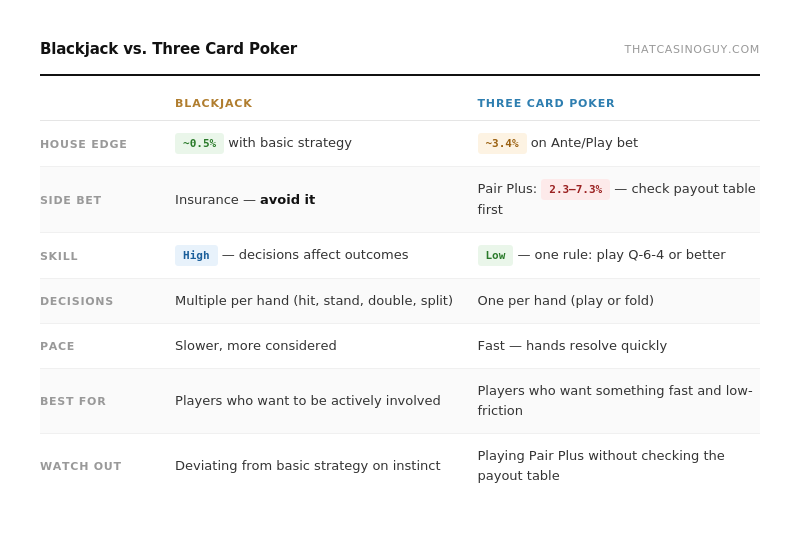
Blackjack played with basic strategy carries a house edge somewhere around 0.5% or less depending on the specific rules of the table. Basic strategy is the mathematically optimal set of decisions for every hand, and it’s one of the lowest house edges of any game in an online casino.
The catch is that basic strategy is a real thing you have to actually learn and apply. It’s not complicated. It’s a decision chart, and the chart is the same every time. But most players don’t use it consistently. They play hunches, get conservative on hands where the math says hit, get aggressive when they shouldn’t. Every deviation nudges the house edge upward.
Blackjack’s excellent theoretical house edge is available to you, but you have to do the work to access it. The game rewards players who take it seriously.
The Three Card Poker Math, Quickly
Three Card Poker typically runs a house edge somewhere in the 3.4% range on the Ante/Play bet when played correctly. That’s meaningfully higher than blackjack at its best, but not outrageous for a table game. And the “played correctly” part is much simpler.
The optimal strategy for the main bet is essentially one rule: play any hand of Queen-6-4 or better, fold everything below it. That’s it. No chart. No scenarios to think through. One decision per hand with one guiding principle.
Where Three Card Poker gets expensive is the Pair Plus side bet. It pays out based purely on whether your three cards form a pair or better, completely independent of the dealer’s hand. It looks appealing because the payouts are visible and dramatic. But the house edge on Pair Plus, depending on the payout table the casino uses, typically runs somewhere between 2.3% and 7.3%. The worse versions of it are among the worst bets at a standard table game. I always check the specific payout table before dropping money on it consistently, and more often than not I leave it alone entirely.
How They Actually Feel to Play
This is where the comparison gets interesting, because the math only tells part of the story.
Blackjack has texture. There’s a rhythm to it. Watching your cards, considering the dealer’s upcard, making a decision, seeing how it plays out. A good session feels engaged. When something goes wrong, you can usually trace it back to a moment. When it goes right, there’s a small satisfaction in having played the hand correctly regardless of what the dealer did.
I’ve sat through sessions of online blackjack where I played every hand correctly by the book and still lost, because variance is real and the math plays out over thousands of hands, not dozens. But the engagement doesn’t disappear just because the cards are cold. That’s the part I keep coming back to with blackjack. Even a losing session has something to hold onto.
Three Card Poker is a faster, looser experience. Each hand resolves quickly. The decision is almost mechanical once you’ve internalized the fold threshold. What you’re really there for is the swing, the moments when a strong hand plays out against a qualifying dealer. It’s entertaining in a different register. Less cerebral, more immediate.
I don’t have a strong preference between them. They scratch different itches depending on the session.
Which One Is Actually Better for You
If you want to be an active participant in what’s happening, if the process of making decisions is part of the entertainment, blackjack is the game. The skill ceiling is accessible, the house edge reward for playing well is real, and the engagement over a session is genuine.
If you want something simpler, faster, and lower-friction, where you’re not managing a decision framework but just watching hands play out with one easy rule in your back pocket, Three Card Poker delivers that. Just be honest with yourself about the Pair Plus bet. It’s not where the value lives, and I’d skip it or at minimum check the payout table before you commit to it regularly.
The one thing I’d push back on is the idea that Three Card Poker is “easier” in a way that makes it better for beginners. Lower decision complexity doesn’t mean lower cost. The house edge is higher, the hands resolve faster, and a session can move through your budget more quickly than a slower, considered game of blackjack.
Simpler isn’t always cheaper.
The Quick Reference
Blackjack: Lower house edge (around 0.5% with basic strategy), more decisions, more engagement, rewards players who study even a little. The right choice if you want to feel like an active participant.
Three Card Poker: Higher house edge (around 3.4% on Ante/Play), one real decision per hand, faster session pace, easy to learn. The right choice if you want something frictionless. I’d skip the Pair Plus bet or at least check the payout table first.
Both are worth knowing. The casino lobby doesn’t explain either of them this clearly, which is exactly why you should go in with at least this much context.
Gambling is entertainment with a cost attached, so set limits before you play and visit our Responsible Gaming page for support resources, safer-play tools, and help options if gambling stops feeling fun.



Leave a Comment