
Your Casino Lists Visa for Deposits. Here’s Why It Might Not Be There for Withdrawals.

Visa is the most universally accepted deposit method at Canadian online casinos. You enter the card number, the transaction clears in seconds, and the funds appear in your balance before you’ve closed the cashier page. It works so reliably that most players assume the same card will be waiting when they try to withdraw. Then they open the withdrawal tab and Visa isn’t listed at all.
This isn’t a glitch, and it isn’t the casino being difficult. It’s a structural feature of how credit card payment networks handle gambling transactions in Canada. The asymmetry between deposits and withdrawals is baked into the processing layer, and once you understand why, the cashier page stops being confusing and starts being predictable.
The distinction matters because it affects how quickly you actually receive your money. Choosing the wrong withdrawal method because you expected Visa to be there can add days to the process.
How Visa Deposits Actually Work at Online Casinos
When you deposit with Visa at a Canadian online casino, the transaction is processed as a purchase. Your card issuer sees it the same way it sees a charge at a retailer or a subscription service. The casino’s payment processor submits the charge, your bank authorises it, and the funds move. The whole cycle takes seconds because the infrastructure for card-not-present purchases has been optimised for decades.
This is why Visa deposits are instant at virtually every operator. The rails are fast, the authorisation is automated, and the casino receives confirmation in real time. Whether you’re using a Visa credit card, a Visa debit card, or a prepaid Visa, the deposit path is essentially the same. The transaction code might differ, but the speed doesn’t.
What most players don’t realise is that this entire process is a one-way mechanism. The purchase authorisation network is designed to move money from cardholder to merchant. It was never built to move money back the other way on demand.
Why the Withdrawal Page Looks Different
Sending money back to a Visa card requires a completely different process called a credit refund or, in some cases, Visa Direct. A credit refund reverses a charge through the same network, but it doesn’t happen instantly. It passes through the acquirer, the card network, and the issuing bank, and each step adds processing time. Typical timelines for a Visa credit refund are two to five business days after the casino approves the withdrawal.
But here’s the part that catches people: not every casino has the processing agreements in place to push withdrawals back to Visa. The merchant account that handles deposits doesn’t automatically support outbound payments. Some payment processors offer it, others don’t, and the casino’s contract determines which direction the money can flow. That’s why you’ll find operators that accept Visa deposits without issue but list only Interac e-Transfer, bank wire, or e-wallets on the withdrawal side.
It’s not that the casino is steering you toward a worse option. It’s that the deposit pipeline and the withdrawal pipeline are two separate systems with different capabilities.
Credit Cards vs. Debit Cards: The Split Gets Wider
If you deposited with a Visa credit card, the withdrawal picture gets even more complicated. Many Canadian credit card issuers block incoming gambling credits entirely. Even if the casino supports Visa withdrawals, your bank might reject the return transaction or code it as a cash advance, which carries its own fees and interest charges from day one. There’s no grace period on a cash advance the way there is on a regular purchase.
Visa debit cards have a slightly better track record for withdrawals because the funds return directly to a chequing account rather than a credit line. But “slightly better” still means “check first.” Some issuing banks in Canada still decline inbound gambling transactions on debit cards, and the casino’s cashier page won’t always tell you whether your specific card will work until the withdrawal attempt either succeeds or fails.
I’ve seen enough cashier pages to know the pattern: if Visa withdrawals are available at all, the operator usually specifies “Visa Debit only” somewhere in the terms. If it just says “Visa” on the deposit page and nothing on the withdrawal page, assume you’ll need a different method to get your money out.
What This Means for Your Withdrawal Plan
The practical consequence is simple: check the withdrawal methods before you deposit, not after you’ve won. If you deposit $100 with Visa and the only withdrawal options are bank wire (which often carries a $25 to $50 fee and takes three to seven business days) or an e-wallet you haven’t set up, you’ve created friction that didn’t need to exist.
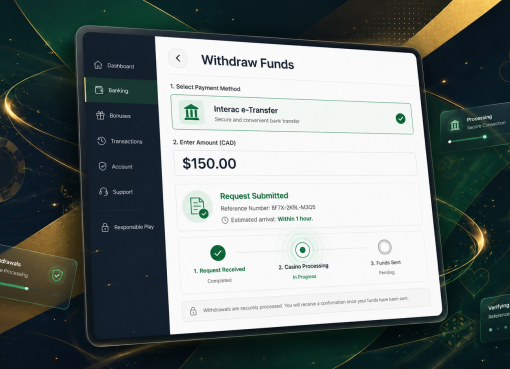
Interac e-Transfer is the cleanest workaround for Canadian players. Most operators that accept Interac for deposits also offer it for withdrawals, and the transfer times are typically one to three business days after the casino’s internal review. The deposit-and-withdrawal symmetry that Visa lacks is exactly what Interac provides.
Some casinos do allow you to withdraw to a method you didn’t deposit with, but many require that your first withdrawal matches your deposit method for anti-fraud reasons. If Visa isn’t available for withdrawals, the casino will usually redirect you to the next eligible option. That redirect is where delays happen, because you might need to verify a new payment method before the withdrawal processes.
The KYC Layer Adds Another Step
When a withdrawal goes to a different method than the deposit, operators typically trigger additional KYC verification. The casino needs to confirm that the withdrawal destination belongs to the same person who deposited. This is standard anti-money-laundering procedure, not the casino stalling.
But the timing matters. If you deposited with Visa, requested a withdrawal to Interac e-Transfer, and haven’t completed identity verification yet, you’re looking at the casino’s internal review period plus the KYC document review plus the actual transfer time. At some operators, that sequence can stretch to five to ten business days for a first withdrawal. Completing KYC early, before you ever request a withdrawal, compresses that timeline significantly.
The players who get frustrated by withdrawal times are almost always the ones who assumed the cashier page would work the same way going out as it did coming in. It doesn’t, and the Visa asymmetry is the single most common reason why.
Honest Assessment
The Visa deposit-withdrawal gap isn’t a casino trick. It’s a payment infrastructure reality that predates online gambling. Credit card networks were built to take payments, not distribute them, and gambling transactions sit in a regulatory and processing category that makes return payments even harder. Canadian card issuers add their own layer of restrictions on top of that.
The fix is straightforward: use Interac e-Transfer for both deposits and withdrawals whenever it’s available. It’s the one method in the Canadian market where the deposit experience and the withdrawal experience are close to symmetrical. If you prefer using Visa for deposits because of rewards points or credit float, that’s a valid choice, but build your withdrawal plan around a different method from the start. Don’t discover the gap after you’ve already requested a payout.
The cashier page tells you everything you need to know. Most players just check it in the wrong order.
Every casino cashier page has two sides. The deposit side is designed to be fast and frictionless because that’s where the operator’s incentive sits. The withdrawal side is where the actual payment infrastructure shows itself. Checking both before you fund your account isn’t paranoia. It’s the difference between a two-day withdrawal and a ten-day one.
Gambling is entertainment with a cost attached, so set limits before you play and visit our Responsible Gaming page for support resources, safer-play tools, and help options if gambling stops feeling fun.


Leave a Comment