
Your Interac Deposit Was Instant. Your Interac Withdrawal Won’t Be. Here’s Why.
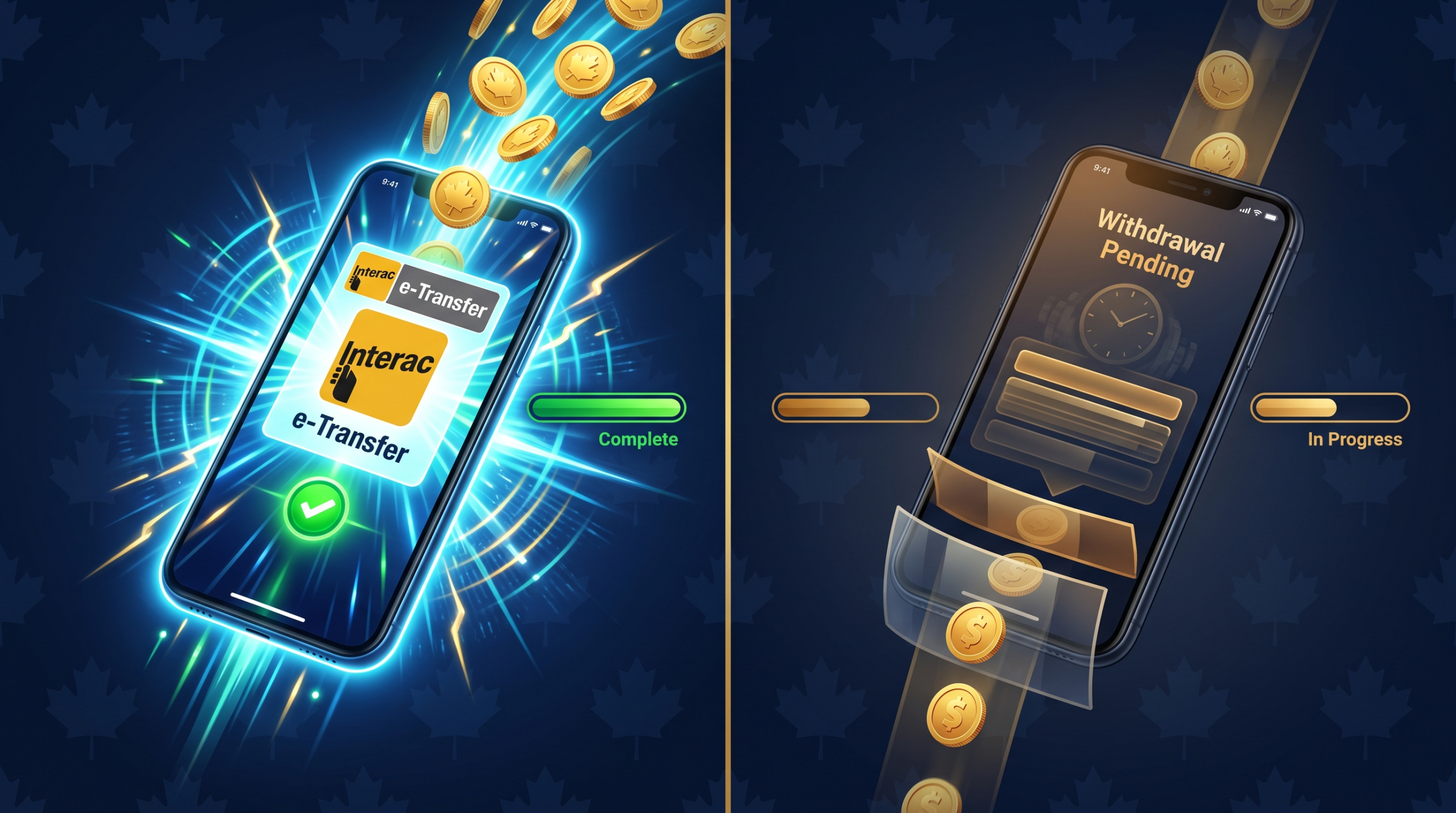
Every Canadian casino player has had the same moment. You deposit $50 through Interac e-Transfer, and it’s in your casino balance before you’ve put your phone down. Three weeks later, you withdraw $200 through the same method, and it takes four days to reach your bank account. Same payment rail. Same bank. Completely different experience.
The instinct is to blame the casino, and sometimes that’s fair. But the real explanation is more structural than that. Deposits and withdrawals don’t travel the same path, don’t pass through the same checks, and don’t operate under the same incentives. The speed gap isn’t a glitch. It’s baked into how online casino payments work in Canada, and understanding each stage gives you more control over when your money actually arrives.
Here’s what’s actually happening on both sides of that transaction, and what you can do about the parts that are within your control.
Why Deposits Are Instant (and Why That’s the Easy Part)
An Interac e-Transfer deposit is, from the casino’s perspective, the simplest transaction it processes. You initiate the transfer from your banking app, Interac confirms the funds are real and available, and the casino credits your account. The whole thing typically completes in under 60 seconds. There’s no identity review, no fraud check on the casino’s end, and no compliance hold. The money is moving toward the casino, which means the risk profile is essentially zero for the operator.
This is the part most players don’t think about. Deposits are fast because the casino has no reason to slow them down. Your bank has already verified the funds. Interac has already handled the transfer mechanics. The casino just needs to receive and credit. There’s no regulatory requirement to review an incoming deposit before it hits your balance, and no operator in any market has ever had a business incentive to add friction to the deposit process.
The speed of your deposit isn’t a sign that the casino is well-run. It’s the default. Every operator, from provincially regulated platforms to grey market sites, processes Interac deposits at roughly the same speed. The deposit experience tells you almost nothing about how the casino handles the part that actually matters.
The Three Stages of a Casino Withdrawal (and Where the Delay Lives)
When you request a withdrawal, your money passes through three distinct stages before it reaches your bank account. Each stage has its own timeline, its own owner, and its own potential for delay. Most players see one number in their transaction history and assume the whole process is a single event. It isn’t.
Stage one is the pending period. This is the window between when you click “withdraw” and when the casino’s payment team actually begins processing. At some operators, this is 24 hours. At others, it’s 48 to 72 hours. A few grey market sites stretch it to five business days. During this window, many casinos allow you to reverse the withdrawal and put the funds back into your playable balance. That reversal option isn’t accidental. It’s a retention mechanic, and it’s one of the most dangerous features in any casino account.
Stage two is internal review. This is where the casino checks your account for bonus compliance, verifies your identity if KYC hasn’t been completed, and runs whatever anti-fraud and anti-money-laundering checks their licence requires. Under Ontario’s regulatory framework, operators must complete these checks before releasing funds. This stage can take anywhere from a few hours to several business days, depending on whether you’ve already verified your identity and whether the withdrawal triggers any manual review thresholds.
Stage three is the actual transfer. Once the casino approves the withdrawal, the money moves through Interac back to your bank. This part is typically fast, often same-day or next business day. But by the time you reach stage three, you’ve already waited through stages one and two. The Interac transfer itself isn’t the bottleneck. The casino’s internal process is.
KYC Is the Single Biggest Variable
Know Your Customer verification is the step that turns a 24-hour withdrawal into a five-day withdrawal for most first-time cashouts. The pattern is predictable. You deposit, you play, you win, you request a withdrawal, and the casino asks for a photo of your government ID, a selfie, and sometimes a utility bill or bank statement. Until those documents are reviewed and approved, your withdrawal sits in a queue.
KYC review timelines vary wildly. I’ve seen operators that verify documents within four hours. I’ve seen others where the review takes three to five business days, with no status updates in between. The operator’s published timeline is often optimistic. The actual experience depends on staffing, volume, and whether your documents triggered a manual escalation.
The fix is simple and almost nobody does it: complete KYC before you ever request a withdrawal. Most casinos allow you to upload documents at any time through your account settings. If your ID is already verified when you hit the withdrawal button, you skip the longest single delay in the entire process. It won’t eliminate the pending period or the internal review, but it removes the one stage that routinely adds days.
The Pending Period Isn’t Just Administrative. It’s Strategic.
The pending period deserves its own scrutiny because it serves the casino more than it serves the player. A 24-to-72-hour window before processing begins is standard across the industry, and operators will tell you it exists for security and compliance reasons. That’s partially true. But the reversible withdrawal feature that lives inside that window tells you the rest of the story.
During the pending period, some casinos display your withdrawal as a cancellable request. You’ll see a button that says “cancel withdrawal” or “return to balance.” Every hour that money sits in pending status is an hour where a player who’s had a bad session, or who’s simply impatient, might reverse the withdrawal and keep playing. The industry knows this. The data on reversal rates is closely guarded, but the feature wouldn’t exist if it didn’t work.
Provincially regulated operators in Ontario are required to process withdrawals without unnecessary delay, and some have shortened or eliminated the reversible window. Grey market operators have no such obligation. If you’re playing on a site where the pending period stretches beyond 48 hours and the reversal button is prominently displayed, that’s not a compliance feature. That’s a design choice, and it’s not designed for you.
What “Approved” Actually Means (and Doesn’t Mean)
One of the most common complaints I’ve seen from Canadian players is some version of: “My withdrawal was approved two days ago and I still don’t have my money.” The word “approved” is doing a lot of heavy lifting in casino transaction histories, and it doesn’t mean what most players think it means.
“Approved” means the casino has completed its internal review and authorised the release of funds. It does not mean the money has been sent. There’s often a gap between approval and the actual initiation of the Interac transfer, especially if the casino batches outgoing payments at specific times. Some operators process outgoing transfers once per business day. Others batch twice daily. A withdrawal approved at 5 p.m. on a Friday might not be initiated until Monday morning, and then Interac’s own processing adds another business day.
The practical difference between “approved” and “sent” can be 24 to 48 hours on its own. Add that to the pending period and the KYC review, and a withdrawal that should take two days ends up taking five or six. None of those individual stages is unreasonable. But stacked together, with no transparency about which stage you’re in, the experience feels deliberately opaque. Because, in many cases, it is.
What You Can Actually Control
You can’t change the casino’s internal processing schedule or batch payment timing. But you can eliminate the delays that are within your control, and they’re more significant than most players realise.
Complete KYC verification the day you create your account. Upload your ID, your selfie, and your proof of address before you’ve even made a deposit. This removes the single longest variable from your first withdrawal. Check whether the casino offers Interac for withdrawals, not just deposits. Some operators accept Interac deposits but only process withdrawals via bank wire or cheque, which adds days or weeks. The cashier page usually lists withdrawal methods separately from deposit methods. Read both lists.
Time your withdrawal requests for early in the business week. A request submitted Monday morning moves through the queue faster than one submitted Friday evening, simply because of business-day processing windows. And if the casino offers a reversible pending period, treat it as a test of the operator’s priorities. A short or non-reversible pending window is a sign the casino isn’t relying on you to change your mind.
Honest Assessment
The speed gap between Interac deposits and withdrawals isn’t a technical limitation. Interac can move money in both directions quickly. The delay lives almost entirely inside the casino’s internal process, and while some of that process is genuinely required for compliance and security, the rest is a product of business incentives that don’t align with yours. Casinos have every reason to make deposits frictionless and no commercial motivation to make withdrawals equally fast.
The best operators process withdrawals within 24 hours of request, including KYC review for verified accounts. The worst stretch it to a week or more with no communication about which stage your money is sitting in. That gap in withdrawal speed tells you more about an operator’s priorities than anything on its homepage. When I’m evaluating a casino, the withdrawal timeline is one of the first things I look at, and it should be one of the first things you ask about before you deposit a dollar.
The deposit experience is designed to feel seamless because seamless deposits serve the operator. The withdrawal experience is where you find out whether the operator also serves you. Next time you’re comparing two casinos and the bonus offers look identical, check the published withdrawal timelines instead. That’s where the real difference lives.
Gambling is entertainment with a cost attached, so set limits before you play and visit our Responsible Gaming page for support resources, safer-play tools, and help options if gambling stops feeling fun.


Leave a Comment