
Reality Checks Exist in Every Casino. Almost Nobody Uses Them. That’s a Design Problem.
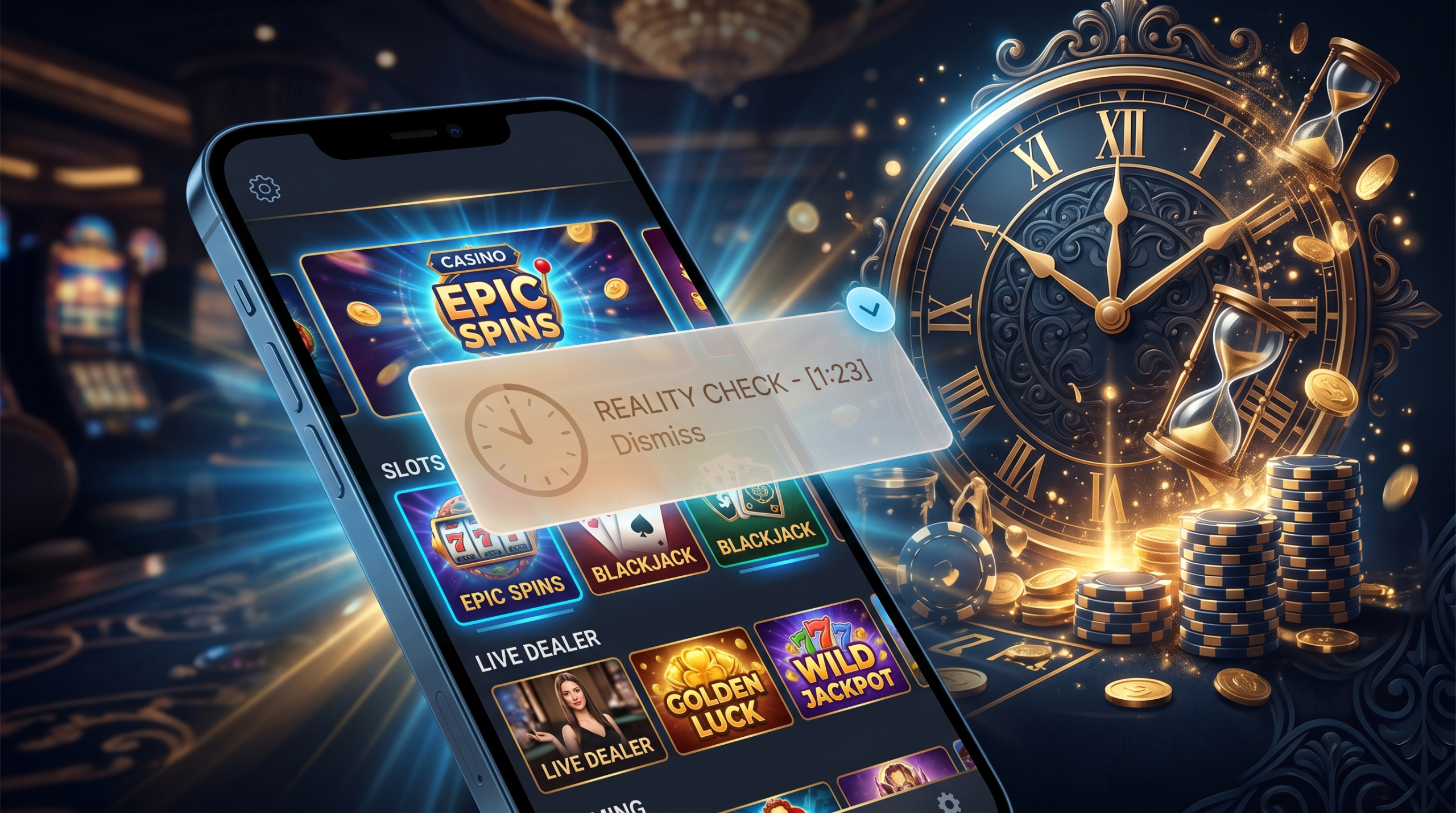
Every regulated online casino in Canada offers a reality check feature. It’s a simple tool: a pop-up that tells you how long you’ve been playing and, in most cases, how much you’ve deposited or lost during that session. It’s the kind of feature that sounds genuinely useful when you describe it out loud. And almost nobody turns it on. That’s not because players are careless or don’t care about their own habits. It’s because the way these tools are designed, positioned, and presented practically guarantees they’ll be ignored.
This isn’t a complaint about regulation. Reality checks exist because regulators recognised that time distortion is one of the most powerful forces in gambling. You sit down for twenty minutes and look up an hour later. That’s not a metaphor. It’s a measurable, well-documented cognitive effect, and it’s amplified by every design choice a casino makes: no clocks, no natural light cues, autoplay spinning in the background, seamless session flow. A reality check is supposed to interrupt that. In theory, it’s one of the most player-friendly tools available.
In practice, the gap between what these tools could do and what they actually do is worth examining closely. Because the issue isn’t the concept. It’s the execution.
What a Reality Check Actually Does
A reality check is a timed notification. You set an interval, typically between 15 minutes and 60 minutes, and the casino displays a pop-up at that interval telling you how long you’ve been logged in. Some versions include your net session result. Some just show elapsed time. Most give you two options: continue playing or log out.
Under Ontario’s regulatory framework, operators registered with iGaming Ontario are expected to offer session-time tools. The specifics vary by operator, but the principle is consistent: give players a mechanism to check in with themselves during play. Alberta’s framework, which goes live in its current expanded form in 2025, includes similar expectations for responsible gambling toolsets.
The tool itself is straightforward. The problem starts with how you find it and what happens when it fires.
Buried Three Menus Deep
I’ve looked at the responsible gambling settings pages of more than a dozen regulated Canadian casino sites. The pattern is remarkably consistent. Reality check settings are typically located inside a “Responsible Gambling” or “Safer Play” section, which is itself inside an “Account Settings” or “My Account” menu, which is accessed through a small icon in the top corner of the screen. That’s three navigation steps from the lobby. On mobile, it can be four.
Compare that to the bonus banner, which occupies the entire screen the moment you log in. Or the deposit button, which is visible on every single page. The casino’s revenue-generating features are designed with zero friction. The player-protection features are designed with maximum friction. That’s not an accident. It’s a set of design priorities made visible.
No operator I’ve seen presents the reality check option during the sign-up flow. No operator I’ve seen prompts a new player to set one before their first session. The tool exists. It’s just not introduced at the moment it would be most useful.
The Dismissal Problem
Even when a player does enable a reality check, the notification itself is designed to be dismissed in under two seconds. It appears as a small pop-up, often in the centre of the screen but sometimes as a banner at the top. It shows a number. It offers two buttons. One says “Continue.” The other says “Log Out” or “Close Session.” The continue button is almost always more prominent, larger, or more brightly coloured.
This is the same UX pattern used in cookie consent banners, app update prompts, and subscription renewal notices. It’s a pattern specifically engineered to make the default action a dismissal. In a gambling context, that means the tool designed to make you pause is itself designed to be bypassed without pausing. The pop-up appears mid-spin or between rounds, and the instinct is to close it and keep going. I’ve seen enough of these to know that the notification rarely creates the interruption it’s supposed to.
A reality check that takes less effort to dismiss than it does to read isn’t functioning as a safety tool. It’s functioning as a compliance checkbox.
What a Useful Version Would Look Like
The concept isn’t broken. The implementation is. A reality check that actually served its purpose would do three things differently. First, it would be enabled by default during account registration, with the player choosing an interval rather than choosing whether to activate it at all. The default interval at most sites that offer a preset is 60 minutes. Research on session-length and loss-chasing patterns suggests 30 minutes would be more effective for most players.
Second, the notification would require a meaningful interaction to dismiss. Not a CAPTCHA, not a quiz, but something more than tapping a single button. Showing the player their net session result alongside the time elapsed, and requiring them to confirm they’ve seen both figures before continuing, would add roughly five seconds of friction. That’s enough to break the autoplay trance without being punitive.
Third, the log-out option would be presented with equal or greater visual weight than the continue option. This is basic UX ethics. If the purpose of the tool is to offer a genuine choice, both options need to feel equally available. Right now, the continue button is the hero and the log-out button is the footnote.
Time Distortion Is the Mechanism That Matters
The reason reality checks matter more than most players realise is that time distortion isn’t a minor effect. It’s one of the primary mechanisms through which gambling sessions extend beyond what a player originally intended. Studies on electronic gaming machines consistently show that players underestimate their session length by 30% to 50%. A player who thinks they’ve been playing for 20 minutes has typically been playing for 30 to 40.
Online casinos amplify this. There’s no walk to the bar, no conversation with the person next to you, no physical cue that time is passing. The game fills the screen. The session is seamless. Autoplay removes even the micro-pause of clicking the spin button. In that environment, a well-designed reality check isn’t a nice-to-have. It’s one of the few tools that directly addresses the cognitive distortion most responsible for unplanned spending.
Deposit limits cap the total. Session time limits cap the duration. But a reality check is the only tool that creates a moment of awareness during play, when the player still has the option to change course before hitting a limit they’ve already set. That’s a fundamentally different kind of intervention, and it’s being wasted.
What You Can Do Right Now
If you play at a regulated Canadian casino, the reality check tool is already in your account settings. Finding it takes about 90 seconds. Go to your account menu, look for “Responsible Gambling” or “Safer Play,” and find the session reminder or reality check option. Set it to 30 minutes. That’s the interval I’d recommend for most players, especially on high-volatility games where cold stretches can pull you into longer sessions than you planned.
When the notification appears, actually read it. Look at the time. Look at the net figure if one is shown. Then make a decision rather than reflexively tapping “Continue.” That’s the entire point of the tool, and it only works if you let it interrupt you for the five seconds it needs.
If you’re playing at a site that doesn’t offer a reality check, your phone’s built-in timer works. Set a 30-minute alarm before you open the app. It’s less elegant, but it does the same job. The mechanism matters less than the interruption.
Honest Assessment
Reality checks are one of the best ideas in responsible gambling toolsets and one of the worst implementations. The concept directly targets the cognitive effect most responsible for sessions running longer and costing more than players intended. But the way these tools are buried in menus, dismissed with a tap, and visually biased toward “Continue” means they function more as regulatory compliance artefacts than genuine player-protection features.
The fix isn’t complicated. Default-on activation, meaningful dismissal friction, and equal visual weight for both options would transform these from ignored pop-ups into genuinely useful session management tools. Until operators make those changes, the responsibility falls on players to find the setting, enable it, and actually engage with it when it fires. It shouldn’t work that way, but right now it does. The tool is there. It’s just waiting for you to make it do its job.
The best responsible gambling tools are the ones that work when your judgement is at its weakest. A reality check is built for exactly that moment. The fact that it’s been designed to be ignored doesn’t change what it could do if you let it. Set the interval before your next session, not after.
Gambling is entertainment with a cost attached, so set limits before you play and visit our Responsible Gaming page for support resources, safer-play tools, and help options if gambling stops feeling fun.



Leave a Comment