
How Casino Withdrawals Actually Work in Canada. The Process Nobody Explains Until You’re Waiting.

The deposit takes thirty seconds. You tap a button, confirm through your banking app, and the funds appear in your casino balance almost instantly. The whole thing feels like buying a coffee.
The withdrawal does not feel like buying a coffee.
It involves more steps, more waiting, more documentation, and more variability than most players expect the first time they try it. Not because something has gone wrong. Because that’s how the process is actually built. The casino made the deposit frictionless on purpose. The withdrawal has friction built in by design, by regulation, and by the payment infrastructure sitting between the casino and your bank account.
I’ve processed withdrawals through every major method available to Canadian players. The experience varies more than the FAQ pages suggest. Here’s what actually happens at each stage, and where the delays that frustrate people really come from.
The Request Is Not the Withdrawal
This is the first thing most players get wrong, and it shapes every frustration that follows.
When you hit the withdraw button and confirm the amount, you have not withdrawn money. You have submitted a request. That request enters a queue on the casino’s side. It sits there until someone, or some automated system, reviews it. The review checks your account status, your verification documents, whether any active bonus conditions apply to your balance, and whether the withdrawal amount falls within the platform’s stated limits.
This internal review period is sometimes called the “pending period.” On well-run regulated platforms in Ontario, it’s typically a few hours. On some platforms it can stretch to 24 or 48 hours. On grey market sites, the pending period is whatever the operator decides it is, and it can change without notice.
The pending period is also, on some platforms, the window during which you can reverse the withdrawal and put the money back into your playable balance. That feature exists because some players change their minds. It also exists because the casino knows that a percentage of pending withdrawals get reversed and played through. I’d recommend against using it. Once you’ve decided to cash out, let the request process.
Verification Happens Whether You’re Ready or Not
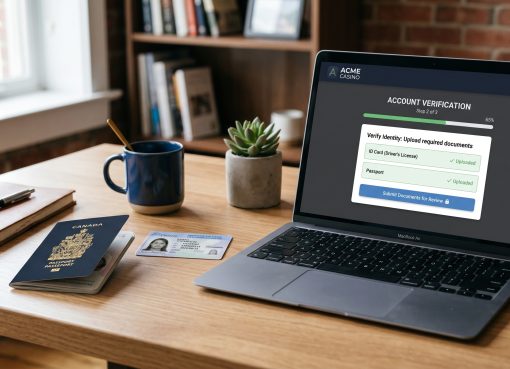
Every legitimate casino in Canada requires identity verification before releasing funds. This is KYC (Know Your Customer) compliance. It’s a regulatory requirement on AGCO-licensed platforms in Ontario, and it’s standard practice even on offshore sites that take Canadian players.
The process typically involves uploading a government-issued photo ID and sometimes a proof of address document, a utility bill or bank statement showing your name and Canadian address. Some platforms also require a photo of the payment method you used to deposit, particularly if it was a credit card.
Here’s where the timing matters. If you completed verification when you created your account, your first withdrawal processes at the same speed as any subsequent one. If you didn’t, your first withdrawal request triggers the verification process, and nothing moves until it’s done. Document review can take anywhere from a few hours to several business days depending on the platform’s support capacity and how clean your uploads are.
I’ve had verification clear in under two hours on a well-staffed Ontario platform. I’ve also waited three days on a site where the support team was clearly processing a backlog. The difference wasn’t the documents I submitted. It was the operator’s internal resourcing.
The practical advice is the same one I give everyone: complete your KYC immediately after account creation. Upload everything before you have a balance you want to withdraw. The five minutes it takes to do this on a Tuesday afternoon saves you the frustration of doing it on a Friday night when you’re sitting on winnings and watching a pending status that won’t move.
Your Deposit Method Decides Your Withdrawal Options
Most Canadian players assume that the method they used to deposit is the method they’ll use to withdraw. That’s often true, but not always, and the exceptions create real confusion.
Interac e-Transfer works cleanly in both directions on most regulated Canadian platforms. You deposit via Interac, you withdraw via Interac. The process is familiar, CAD-denominated, and doesn’t require sharing full banking details with the casino. For the majority of Canadian players, this is the path of least friction.
Credit cards are where it gets complicated. Many platforms accept Visa and Mastercard for deposits but cannot process withdrawals back to the same card. This isn’t the casino being difficult. Card network rules around refund processing make casino-to-card payouts slower and more restricted than other methods. When a credit card withdrawal is available, processing typically takes three to seven business days because the funds travel back through the card network’s refund infrastructure. When it’s not available, the casino will ask you to choose an alternative withdrawal method, usually Interac or bank transfer.
Bank transfers are universally available but consistently the slowest option. Two to five business days is typical. Up to ten days is within the stated range on some platforms. The money gets there. It just takes its time.
The rule I follow: check the withdrawals page before you deposit. Not the deposit page. The withdrawals page. Confirm which methods are available for cashouts, what the processing times are, and whether your preferred deposit method works in both directions. That sixty-second check prevents the most common withdrawal surprise Canadian players encounter.
The Casino’s Queue and Your Bank’s Queue Are Two Different Things
When a platform says “withdrawals processed within 24 hours,” they mean their internal approval and sending process takes up to 24 hours. After that, the money enters the payment network, and the payment network has its own timeline.
For Interac e-Transfer, the second leg is fast. Once the casino sends the transfer, it typically arrives in your banking app within minutes. The total wait is mostly the casino’s queue, not Interac’s.
For bank transfers and credit card refunds, the second leg is where the real delay lives. The casino might approve and send within hours. The bank might take three more business days to make those funds visible in your account. The casino’s stated processing time and the total time you actually wait are two different numbers, and the gap between them is where most of the frustration sits.
I’ve timed this across multiple platforms. A regulated Ontario casino that approves an Interac withdrawal in four hours delivers a total wait of roughly four hours and fifteen minutes. The same casino approving a bank transfer in four hours delivers a total wait of four hours plus three to five business days. Same approval speed. Very different player experience.
When you see a casino advertising “fast withdrawals,” ask which part they’re measuring. The answer matters.
Bonus Conditions Can Block a Withdrawal You Think Is Clean
This catches more players than any processing delay.
If you accepted a bonus and the wagering requirement isn’t fully cleared, your balance includes funds that aren’t yet withdrawable. Most platforms will let you request a withdrawal, but the system will either reduce the amount to your real-money balance only, or reject the request entirely until the bonus conditions are met or forfeited.
The part that trips people up is the distinction between your total balance and your withdrawable balance. They’re displayed differently on different platforms. Some show a single number. Some break it into real money and bonus money. Some show the full balance but only release the real-money portion when you request a cashout. If you’re not sure which portion of your balance is actually yours to withdraw, check the bonus section of your account before you submit the request. On a well-built platform, this information is clear. On a poorly built one, it’s the reason you’re about to have an unpleasant conversation with support.
If you’d rather avoid this entirely, the simplest approach is to decline the bonus on deposits where you want clean withdrawal access. No bonus conditions means no wagering gate between you and your money.
Regulated Platforms Have a Complaint Path. Grey Market Ones Don’t.
Everything I’ve described so far assumes the process works as stated. Most of the time, on most platforms, it does. The question worth asking is what happens when it doesn’t.
On an AGCO-registered platform in Ontario, withdrawal timelines are published in the terms and conditions. If an operator delays a payout beyond those stated limits without valid justification, a player has a formal complaint pathway through iGaming Ontario. The regulator can investigate. The operator faces consequences for patterns of unjustified delays. That accountability structure is what turns a “fast withdrawal” marketing claim into something closer to an enforceable commitment.
On a grey market platform licensed in Curaçao or elsewhere offshore, the withdrawal policy is whatever the operator says it is. If they delay, your options are their internal dispute process and third-party mediation services that have no real enforcement power. Most grey market operators process withdrawals without issue because it’s good business. When one doesn’t, the player’s recourse is limited in a way that regulated players simply don’t face.
The withdrawal experience is where the difference between regulated and unregulated platforms becomes most tangible. Not at deposit. Not in the game lobby. At the cashier, when your money is trying to leave.
The Sequence That Actually Produces a Smooth Cashout
After enough withdrawals across enough platforms, the pattern is clear. The players who have the smoothest experience do the same things in the same order, and they do most of them before they ever need to withdraw.
Complete KYC verification immediately after creating your account. Check the withdrawals page before your first deposit to confirm which methods work in both directions and what the stated processing times are. Decline the bonus if you want unrestricted access to your balance. When you’re ready to cash out, confirm your withdrawable balance, submit the request, and let it process without reversing it.
None of that is complicated. Most of it takes less time than reading about it. The players who end up frustrated are almost never the ones who got unlucky with processing times. They’re the ones who discovered the verification step, the method restriction, or the bonus condition at the exact moment they wanted their money back.
The withdrawal process works. It just works better when you understand its shape before you need it, not after.
Gambling is entertainment with a cost attached, so set limits before you play and visit our Responsible Gaming page for support resources, safer-play tools, and help options if gambling stops feeling fun.


Leave a Comment