
Your Casino Withdrawal Method Isn’t Always Your Deposit Method. Here’s Why the Cashier Page Looks Different Going Out.
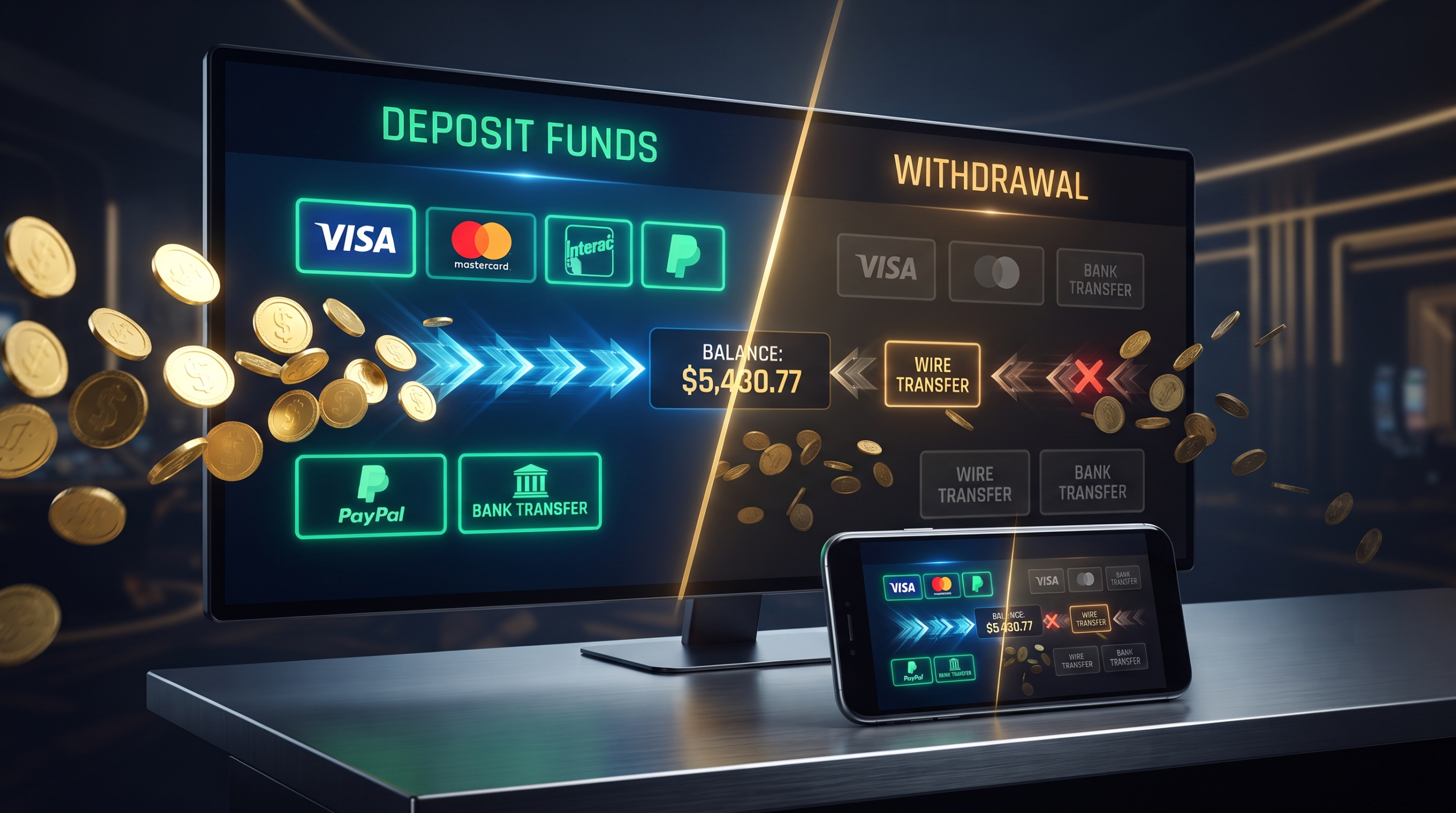
Depositing into a Canadian online casino takes about ninety seconds. You pick Interac, confirm the amount, authenticate with your bank, and the funds land in your casino balance before you’ve closed the banking tab. It’s so fast that most players assume the reverse trip works the same way. Same method, same speed, same simplicity. It doesn’t. The cashier page you see when you go to withdraw often looks nothing like the one you used to deposit, and the difference isn’t a glitch. It’s by design.
This asymmetry is one of the most common sources of frustration for Canadian players, especially newer ones. You picked Interac because it’s what you know. You deposited with it because it was right there. Now you’re trying to cash out and the option has either vanished, been replaced with something you’ve never heard of, or come with conditions nobody mentioned on the way in. The deposit experience was frictionless. The withdrawal experience is where the friction lives.
Understanding why this happens, and what to check before you ever deposit, saves you the unpleasant surprise at the exact moment you’re supposed to be collecting a win.
The Deposit Page and the Withdrawal Page Are Two Different Products
Most players treat the casino cashier like a single system. Money in, money out, same pipes. In practice, the deposit infrastructure and the withdrawal infrastructure are often handled by entirely different payment processors, with different contracts, different fee structures, and different method availability. A casino might process deposits through one payment gateway and withdrawals through another. The methods available on each side depend on the agreements the operator has negotiated, not on what’s technically possible.
This is why you can deposit with Interac e-Transfer at dozens of Canadian-facing casinos but find that withdrawals go out via bank wire, ecoPayz, or a branded prepaid solution instead. The deposit side is optimised for conversion. The operator wants you funded and playing as fast as possible, so they offer every popular Canadian method with instant processing. The withdrawal side is optimised for cost and compliance. Different priorities, different options.
Interac Deposits Don’t Guarantee Interac Withdrawals
This is the specific version of the problem that catches Canadian players most often. Interac e-Transfer is the default deposit method across the Canadian market. It’s fast, familiar, and nearly universal. But Interac availability for withdrawals is a genuinely different question, and the answer varies significantly between operators.
Provincially regulated operators in Ontario typically offer Interac for both deposits and withdrawals. Grey-market casinos are less consistent. Some offer Interac withdrawals with processing times of one to five business days. Others don’t offer Interac withdrawals at all, routing your cashout through a bank transfer that can take three to seven business days, or through an e-wallet you may not have set up. I’ve seen enough cashier pages across Canadian-facing sites to know that the absence of Interac on the withdrawal side, when it was prominently featured on the deposit side, is one of the clearest signals that the operator has prioritised getting your money in over getting it back out.
Before you deposit anywhere, open the withdrawal section of the cashier or the banking page in the terms. If Interac isn’t listed for withdrawals, that’s information you want before your money is in the account, not after.
The “Same Method” Rule Sounds Simple Until It Isn’t
Many operators enforce a rule that withdrawals must go back to the same method used for the deposit, at least up to the deposited amount. This is primarily an anti-money-laundering measure, and it makes sense in principle. If you deposited $200 via Visa, the first $200 of any withdrawal goes back to that Visa card. Anything above that amount might be paid via a different method.
Where this gets complicated is with methods that are deposit-only. If you deposited using a prepaid Visa, a Paysafecard, or certain mobile payment options, the casino can’t return funds to that source. In those cases, the operator typically defaults to a bank wire or asks you to set up an alternative withdrawal method. This can add two to five business days to your withdrawal timeline and may involve additional verification steps. The same-method rule is meant to protect you, but when it collides with a deposit-only payment method, it creates a delay that feels like a penalty for choosing the wrong option at signup.
Minimum and Maximum Withdrawal Amounts Are Method-Specific
This one catches players who assume the withdrawal limits listed on the promotions page apply uniformly. They don’t. Withdrawal minimums and maximums are often set per method, not per account. A casino might allow a $20 minimum withdrawal via e-wallet but require a $50 minimum for a bank transfer. Maximum weekly or monthly withdrawal limits can also vary by method, with bank wires sometimes carrying higher caps than Interac or e-wallet options.
The practical consequence is that your actual withdrawal flexibility depends on which methods are available to you on the cashout side, not just the headline limits in the terms and conditions. If you’re playing at a site where your only withdrawal option is a bank wire with a $50 minimum and a $4,000 weekly cap, that’s a materially different experience than a site offering Interac withdrawals with a $10 minimum and a $10,000 weekly cap. Both might advertise the same welcome bonus. The cashier page tells you which one actually lets you access your money efficiently.
E-Wallets Solve the Problem but Create a New One
Some players work around the deposit-withdrawal asymmetry by using an e-wallet like MuchBetter, ecoPayz, or iDebit. These services typically work in both directions, meaning you can deposit and withdraw through the same channel. Processing times for e-wallet withdrawals are often faster than bank transfers, typically within 24 to 48 hours after the casino’s internal review period.
The trade-off is that you’re adding an intermediary. Your money goes from the casino to the e-wallet, and then from the e-wallet to your bank account. That second leg has its own processing time and, depending on the service, its own fees. Some e-wallets charge a percentage on withdrawals to your bank, or a flat fee for currency conversion if the casino settles in a different currency than CAD. The e-wallet solves the symmetry problem but introduces a cost and a step that a direct Interac withdrawal wouldn’t have. Whether that trade-off makes sense depends on the specific operator and what they’re offering on the withdrawal side without the e-wallet.
What to Check Before You Deposit a Dollar
The cashier page, or the banking section of the terms and conditions, is the single most underread part of any casino site. Most players go straight to the game lobby or the bonus page. The banking page tells you how your money actually moves, and it takes two minutes to read.
Check whether your preferred deposit method is also available for withdrawals. Check the minimum and maximum withdrawal amounts for each available method. Check whether the operator enforces a same-method return policy and what happens if your deposit method is one-directional. Check whether withdrawal processing times are stated per method or as a blanket estimate. If the banking page is vague, that’s a data point too. Operators who are clear about their withdrawal infrastructure tend to be the ones who’ve invested in making it work properly.
This is the kind of thing that takes less time than reading the bonus terms, and it matters more. A generous welcome offer means very little if the path to actually withdrawing your balance is slower, more expensive, or more limited than you expected.
Honest Assessment
The asymmetry between deposit and withdrawal methods at Canadian online casinos isn’t accidental, and it isn’t going away. Deposits are a revenue event for the operator. Withdrawals are a cost. The infrastructure reflects that priority, and it’s the player’s job to understand the difference before committing funds. The single best habit any Canadian casino player can develop is checking the withdrawal page before the deposit page. If Interac is available for deposits but missing from withdrawals, that tells you something about how the operator thinks about the player’s exit experience. Provincially regulated sites in Ontario tend to offer better symmetry here, but even within that market, method availability and processing times vary enough that checking is always worth the two minutes.
The deposit page is the storefront. The withdrawal page is the product.
Every casino makes depositing feel effortless. That’s not generosity. That’s conversion design. The withdrawal side is where you find out what kind of operator you’re actually dealing with. Read the cashier page the way you’d read a contract, because that’s what it is.
Gambling is entertainment with a cost attached, so set limits before you play and visit our Responsible Gaming page for support resources, safer-play tools, and help options if gambling stops feeling fun.



Leave a Comment