
Reality Checks Pop Up Every 30 Minutes. Here’s What Happens When You Dismiss Every Single One.
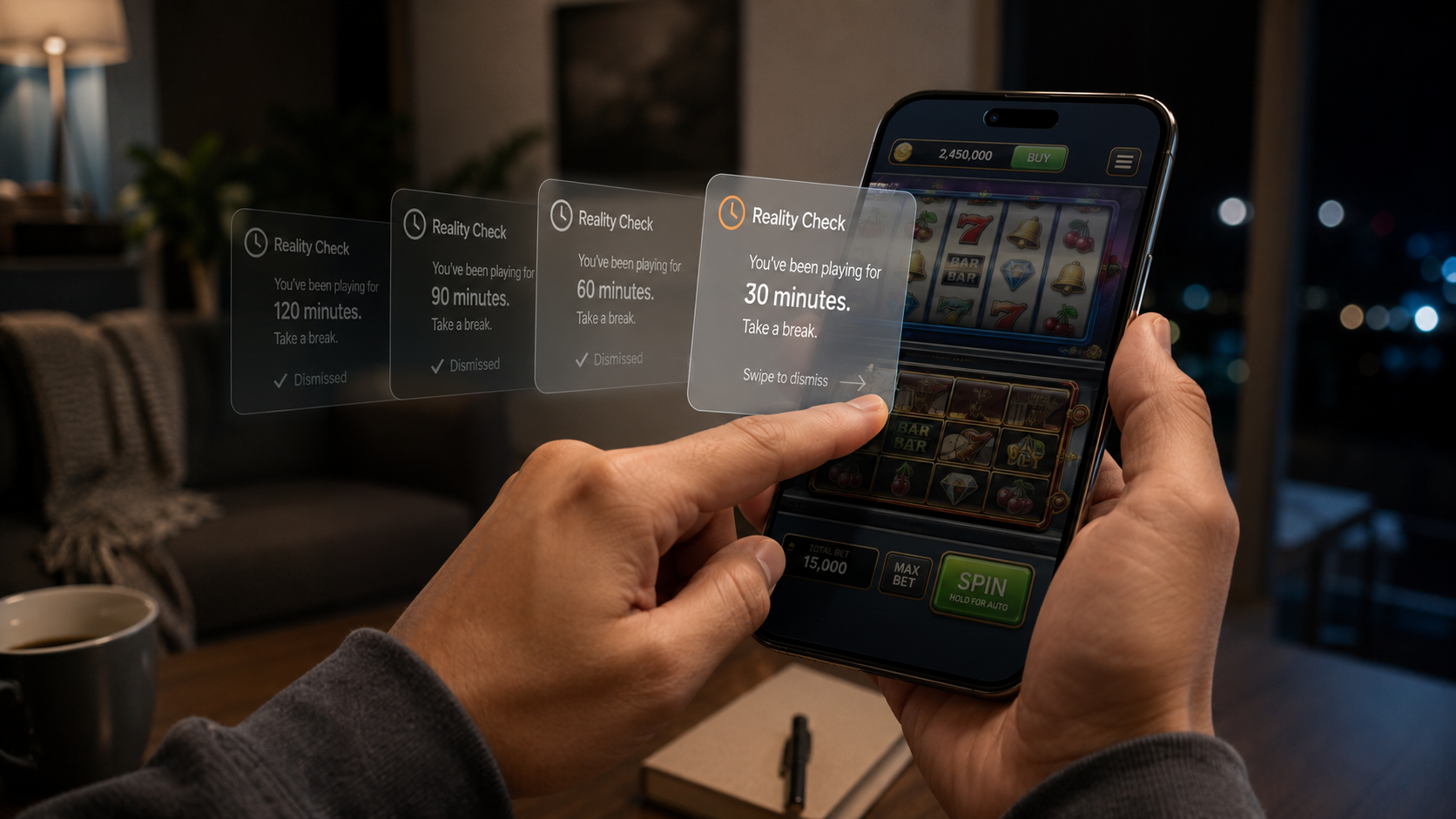
The reality check is the most honest feature in any online casino, and it’s designed to be ignored. That’s not a flaw in the player. It’s a flaw in the feature. A small pop-up appears after a set interval, tells you how long you’ve been playing and sometimes how much you’ve spent, then gives you exactly one option that matters: dismiss it and keep going. The other option, logging out, exists on paper. In practice, almost nobody clicks it.
What makes the reality check worth understanding isn’t the information it shows. It’s the gap between what the tool could do and what it actually does. Provincially regulated operators in Ontario are required to offer session-related notifications under iGaming Ontario’s standards. Offshore sites sometimes include them too, though the implementation varies wildly. Either way, the mechanic is the same: a timed interruption that relies entirely on you choosing to act on it.
That’s a lot of weight to put on a pop-up you’ve already been trained to close.
What a Reality Check Actually Shows You
The standard reality check notification includes two pieces of data: elapsed session time and net position. Some operators show both. Some show only time. A few show deposits made during the session but not losses, which is a distinction that matters more than it looks.
Net position means the difference between what you deposited and your current balance. If you deposited $100 and your balance is $47, the reality check should show you’re down $53. That’s useful information. But it doesn’t account for bonuses added to your balance, pending wagers, or the fact that your “balance” might include non-cashable bonus funds that were never real money in the first place. I’ve written about how your casino balance isn’t always what it appears to be, and reality checks inherit that same ambiguity.
The interval is typically configurable. Most operators default to 30 or 60 minutes. Some let you set it as low as 15 minutes. A few set it at 60 and don’t let you change it. The shorter the interval, the more useful the tool becomes, but also the more likely you are to start dismissing it reflexively.
The Dismiss Button Is the Whole Problem
Here’s the mechanical issue with reality checks as they currently exist at most operators: dismissing the notification takes one click. Continuing to play takes zero additional effort after that click. The pop-up appears, you close it, and you’re back in the same game on the same spin. There’s no friction. No cooldown. No forced pause.
Compare that to what happens when you try to log out. You leave the game, navigate to your account, confirm the logout, and break the entire session flow. The effort gap between “dismiss and continue” and “actually stop” is enormous. The feature is architecturally biased toward continuation.
This isn’t speculation about design intent. It’s observable in how the tools are built. A reality check that paused the game for 60 seconds before allowing play to resume would be a fundamentally different tool. A reality check that required you to re-enter your password after three consecutive dismissals would be a different tool. Those versions don’t exist at most operators. What exists is a notification that functions almost identically to a cookie consent banner: something you close to get back to what you were doing.
What the Pop-Up Doesn’t Tell You
The reality check shows you a snapshot. It doesn’t show you a trend. After 90 minutes, you see that you’re down $120. What you don’t see is that you were down $40 at the 30-minute mark, broke even at 55 minutes, and have been chasing since. The trajectory matters more than the number, and no reality check I’ve encountered at a Canadian-facing operator provides it.
It also doesn’t show you what you’ve wagered. Being down $120 after wagering $300 is a very different session from being down $120 after wagering $2,400. The second scenario means you’ve been cycling through money rapidly, which is a pattern associated with higher-volatility play and loss chasing. Your transaction history contains this data, but the reality check doesn’t surface it.
Time-of-day context is missing too. A 90-minute session at 7 p.m. on a Saturday is different from a 90-minute session at 3 a.m. on a Tuesday. The reality check treats them identically.
Where Reality Checks Sit in the Responsible Gambling Stack
Online casinos operating in regulated Canadian markets typically offer a suite of responsible gambling tools: deposit limits, loss limits, session time limits, cooling-off periods, and self-exclusion. Reality checks sit near the bottom of that stack in terms of actual protective power. They’re informational, not restrictive. They tell you something. They don’t stop anything.
A deposit limit physically prevents you from adding more money. A session time limit logs you out. A self-exclusion locks the account. These are hard stops. A reality check is a soft nudge. It’s the difference between a seatbelt and a dashboard light. Both have a role. One of them actually holds you in place.
That doesn’t make reality checks useless. For a player who’s genuinely lost track of time, seeing “you’ve been playing for 2 hours and 15 minutes” can be a genuine interruption to autopilot. But the tool only works if the player is in a state where information changes behaviour. If you’re deep in a loss-chasing cycle, a pop-up showing you’re down $200 isn’t new information. You already know. The pop-up just confirms it and then lets you keep going.
How to Make the Feature Work Harder for You
If your operator lets you configure the interval, set it to the shortest option available. Fifteen minutes is better than 30. Thirty is better than 60. The more frequently the interruption arrives, the harder it is to fully tune out.
Pair the reality check with a deposit limit. The reality check shows you where you are. The deposit limit prevents you from going further. Used together, they cover the gap that each one leaves open individually. I’ve covered what deposit limits don’t protect you from, and the same logic applies here: no single tool does the job alone.
Make a rule before the session starts: if the reality check shows you’re down more than a specific amount, you log out. Not “think about it.” Log out. The decision has to be made before the pop-up appears, because in the moment, the dismiss button will always feel easier. Write the number down if you have to. $50, $100, whatever your session budget is. The reality check becomes a different tool entirely when it’s tied to a pre-committed decision rather than an in-the-moment judgement call.
Honest Assessment
Reality checks are a minimum-viable responsible gambling feature. They exist because regulators expect operators to offer session awareness tools, and a timed pop-up is the cheapest version of that expectation. They’re not cynical. They’re just not ambitious. The information they provide is real and sometimes genuinely useful. The mechanism for acting on that information is almost comically easy to bypass.
The players who benefit most from reality checks are the ones who were already close to making a good decision. If you’ve been playing for two hours and some part of you knows it’s time to stop, the pop-up can be the thing that tips you toward logging out. If you’re not in that headspace, the pop-up is wallpaper. The feature works at the margins, and for a lot of players, the margins are exactly where sessions go wrong. But treating it as a safety net is a mistake. It’s a reminder, not a guardrail. Use it like one.
The real question is whether operators will ever build reality checks that introduce genuine friction. Mandatory pauses, escalating intervals after consecutive dismissals, pattern-based alerts. The technology is trivial. The incentive structure is the obstacle. A player who dismisses a pop-up and keeps playing is still a player. A player who hits a forced 60-second pause might close the tab. Until regulators mandate friction, the dismiss button will keep doing exactly what it was designed to do.
Reality checks are the only feature in your casino account that regularly tells you something you might not want to hear. The problem isn’t the message. It’s that closing the messenger takes less effort than reading it. Set the interval short, tie it to a number you chose before the session started, and treat the dismiss button like it costs something. Because in the ways that matter, it does.
Gambling is entertainment with a cost attached, so set limits before you play and visit our Responsible Gaming page for support resources, safer-play tools, and help options if gambling stops feeling fun.


Leave a Comment